On the Cave of the Nymphs
Porphyry · tr. Thomas Taylor · 1917
The edition
- Author
- Porphyry
- Title
- On the Cave of the Nymphs
- Translator
- Thomas Taylor
- Year
- 1917
- Source edition
- Porphyry, On the Cave of the Nymphs, trans. Thomas Taylor (London: John M. Watkins, 1917)
- Scanned from
- Internet Archive identifier:
onthecaveoftheny00porpuoft - Language
- English
How to cite
Porphyry, On the Cave of the Nymphs, trans. Thomas Taylor (London: John M. Watkins, 1917). The Neoplatonic Library, version 1.0.0. https://neoplatonic-library.org/
The reader
1. p. 5
I i. What does Homer obscurely signify by the cave in Ithaca, which he describes in the following verses?"High at the head a branching olive grows
And crowns the pointed cliffs with shady boughs.
A cavern pleasant, though involved in night,
Beneath it lies, the Naiades' delight:
Where bowls and urns of workmanship divine
And massy beams in native marble shine;
On which the Nymphs amazing webs display,
Of purple hue and exquisite array.
The busy bees within the urns secure
Honey delicious, and like nectar pure.
Perpetual waters through the grotto glide,
A lofty gate unfolds on either side;
That to the north is pervious to mankind:
The sacred south t'immortals is consign'd."That the poet, indeed, does not narrate these particulars from historical information, is evi dent from this, that those who have given us56a description of the island, have, as Cronius1says, made no mention of such a cave being found in it. This likewise, says he, ismanifest, that it wnnlrf hf> ahgrn-j fpr to expectTthat in_d^scfi5mga cave fabricated^jnerely by poetical license and thus artificially opening a path to Gods and men in the region of Ithaca, he should gam the behei of man-kind. Andit is equally absurd to suppose, that nature herself should point out, in this place, one path for the descent of all mankind, and again another path for all the Gods. For, indeed, the whole world is full of Gods and men; but it is impossible to be persuaded, that in the Ithacensian cave men descend, and Gods ascend. Cronius therefore, having premised this much, says, that it is evident, not only to the wise but also to the vulgar, that the poet, under the veil of allegory, conceals some mysterious signification; thus compel ling others to explore what the gate of men is, and also what is the gate of the Gods: what means by asserting that this cave of the Nymphs has two gates; and why it is both pleasant and obscure, since darkness is by no means delightful, but is rather productive of aversion and horror. Likewise, what is the7reason why it is not simply said to be the cave of the Nymphs, but it is accurately added, of the Nymphs which are called Naiades? Why also, is the cave represented as containing bowls and amphorae, when no mention is made of their receiving any liquor, but bees are said to deposit their honey in these vessels as in hives? Then, again, why are oblong beams adapted to weaving placed here for the Nymphs; and these not formed from wood, or any other pliable matter, but from stone, as well as the amphorae and bowls? Which last circumstance is, indeed, less obscure; but that, on these stony beams, the Nymphs should weave purple garments, is not only wonderful to the sight, but also to the auditory sense. For who would believe that Goddesses weave garments in a cave involved in dark ness, and on stony beams; especially while he hears the poet asserting, that the purple webs of the Goddesses were visible. In addition to these things likewise, this is admirable, that the cave should have a twofold entrance; one made for the descent of men, but the other for the ascent of Gods. And again that the gate, which is pervious by men, should be said to be turned against the north wind, but the8portal of the Gods to the south; and why the poet did not rather make use of the west and the east for this purpose, since nearly all temples have their statues and entrances turned towards the east; but those who enter them look towards the west, when standing with their faces turned towards the statues they honour and worship the Gods. Jlence, since this narration is full of siirh nhgriirit;ifif::J it can neither be a fiction casually devised foiL _the purpose of procuring delight, nor an ex position of a topical history; but something allegorical must be indicated in it by the ooetT who likewise mvsticallyplaces an olive near thecaye. All which particulars the ancients thought very laborious to investigate and un fold; and we, with their assistance, shall now endeavour to develop the secret meaning of the allegory. Those persons, therefore, appear to have written very negligently about the situa tion of the place, who think that the cave, and what is narrated concerning it, are nothing more than a fiction of the poet. But the best and most accurate writers of geography, and among these Artemidorus the Ephesian, in the fifth book of his work, which consists of eleven books, thus writes: "The island of Ithaca,9containing an extent of eighty-five stadia2is distant from Panormus, a port of Cephalenia, about twelve stadia. It has a port named Phorcys, in which there is a shore, and on that shore a cave, in which the Phaeacians are reported to have placed Ulysses." This cave, therefore, will not be entirely an Homeric fiction. But whether the poet describes it as it really is, or whether he has added some thing to it of his own invention, nevertheless the same inquiries remain; whether the in tention of the poet is investigated, or of those who founded the cave. For, neither did the ancients establish temples without fabulous symbols, nor does Homer rashly narrate the particulars pertaining to things of this kind. But how much the more anyone endeavours to show that this description of the cave is not an Homeric fiction, but prior to Homer was consecrated to the Gods, by so much the more will this consecrated cave be found to be full of ancient wisdom. And on this account it deserves to be investigated, and it is requisite that its symbolical consecra tion should be amply unfolded into light.
Every word of the volume follows, exactly as the transcription has it; the reader above shows the same text with the repairs recorded as rules, which is why one page of this book can read two ways.
The text
Contents 34 sections
- ON THE
- CAVE OF THE NYMPHS IN
- THE THIRTEENTH BOOK OF
- THE ODYSSEY
- ON THE
- CAVE OF THE NYMPHS IN
- THE THIRTEENTH BOOK OF
- THE ODYSSEY
- ON THE CAVE OF THE NYMPHS II
- PRINTED IN GREAT BRITAIN BY NEILL AND CO., LTD., EDINBURGH.
- AN ESSAY ON THE BEAUTIFUL
- FROM THE GREEK OF PLOTINUS
- ON THE CAVE OF THE NYMPHS
- FROM THE GREEK OF PORPHYRY
- WORDS OUT OF THE SILENCE
- THE LOVE NET
- SOME PRAYERS AND A VISION
- SUDDEN DEATH &THE WAR
- NARADA SUTRA
- AN INQUIRY INTO LOVE
- THE SCROLL OF THE DISEMBODIED MAN
- JOHN M. WATKINS,
- THE GOSPEL OF MANHOOD
- MYSTICISM AND WAR
- SOME ASPECTS OF
- MYSTICISM IN ISLAM
- CREATIVE THOUGHT & THE PROBLEM OF EVIL
- SWEDENBORG
- THE SAVANT AND THE SEER
- THE TREND OF PSYCHICAL RESEARCH
- NOTES ON THE LORD'S PRAYER
- JOHN M, W ATKINS,
- PLEASE DO NOT REMOVE CARDS OR SLIPS FROM THIS POCKET
- UNIVERSITY OF TORONTO LIBRARY
PA
4397
E5
08
1917
ON THE
CAVE OF THE NYMPHS IN
THE THIRTEENTH BOOK OF
THE ODYSSEY
On the
Cave of the Nymphs in
the Thirteenth Book of
the Odyssey
From the Greeh of Porphyry
Translated by
Thomas Taylor
q
London
John M. Watkins
21 Cecil Court, Charing Cross Road
1917
ON THE
CAVE OF THE NYMPHS IN
THE THIRTEENTH BOOK OF
THE ODYSSEY
I i. What does Homer obscurely signify by the cave in Ithaca, which he describes in the following verses ?
" High at the head a branching olive grows And crowns the pointed cliffs with shady boughs. A cavern pleasant, though involved in night, Beneath it lies, the Naiades' delight : Where bowls and urns of workmanship divine And massy beams in native marble shine ; On which the Nymphs amazing webs display, Of purple hue and exquisite array. The busy bees within the urns secure Honey delicious, and like nectar pure. Perpetual waters through the grotto glide, A lofty gate unfolds on either side ; That to the north is pervious to mankind : The sacred south t'immortals is consign'd."
That the poet, indeed, does not narrate these particulars from historical information, is evi dent from this, that those who have given us 5
6 ON THE CAVE OF THE NYMPHS
a description of the island, have, as Cronius (note i) says, made no mention of such a cave being found in it. This likewise, says he, is
manifest, that it wnnlrf hf> ahgrn-j fpr
to expectTthat in_d^scfi5mga cave fabricated
^jnerely by poetical license and thus artificially opening a path to Gods and men in the region of Ithaca, he should gam the behei of man-
- • 7 *^
kind. Andit is equally absurd to suppose, that nature herself should point out, in this place, one path for the descent of all mankind, and again another path for all the Gods. For, indeed, the whole world is full of Gods and men; but it is impossible to be persuaded, that in the Ithacensian cave men descend, and Gods ascend. Cronius therefore, having premised this much, says, that it is evident, not only to the wise but also to the vulgar, that the poet, under the veil of allegory, conceals some mysterious signification ; thus compel ling others to explore what the gate of men is, and also what is the gate of the Gods : what means by asserting that this cave of the Nymphs has two gates ; and why it is both pleasant and obscure, since darkness is by no means delightful, but is rather productive of aversion and horror. Likewise, what is the
ON THE CAVE OF THE NYMPHS 7
reason why it is not simply said to be the cave of the Nymphs, but it is accurately added, of the Nymphs which are called Naiades ? Why also, is the cave represented as containing bowls and amphorae, when no mention is made of their receiving any liquor, but bees are said to deposit their honey in these vessels as in hives? Then, again, why are oblong beams adapted to weaving placed here for the Nymphs ; and these not formed from wood, or any other pliable matter, but from stone, as well as the amphorae and bowls ? Which last circumstance is, indeed, less obscure ; but that, on these stony beams, the Nymphs should weave purple garments, is not only wonderful to the sight, but also to the auditory sense. For who would believe that Goddesses weave garments in a cave involved in dark ness, and on stony beams ; especially while he hears the poet asserting, that the purple webs of the Goddesses were visible. In addition to these things likewise, this is admirable, that the cave should have a twofold entrance ; one made for the descent of men, but the other for the ascent of Gods. And again that the gate, which is pervious by men, should be said to be turned against the north wind, but the
8 ON THE CAVE OF THE NYMPHS
portal of the Gods to the south ; and why the poet did not rather make use of the west and the east for this purpose, since nearly all temples have their statues and entrances turned towards the east ; but those who enter them look towards the west, when standing with their faces turned towards the statues they honour and worship the Gods. Jlence, since this narration is full of siirh nhgriirit;ifif::J it can neither be a fiction casually devised foiL _the purpose of procuring delight, nor an ex position of a topical history; but something allegorical must be indicated in it by the ooetT who likewise mvsticallyplaces an olive near thecaye. All which particulars the ancients thought very laborious to investigate and un fold ; and we, with their assistance, shall now endeavour to develop the secret meaning of the allegory. Those persons, therefore, appear to have written very negligently about the situa tion of the place, who think that the cave, and what is narrated concerning it, are nothing more than a fiction of the poet. But the best and most accurate writers of geography, and among these Artemidorus the Ephesian, in the fifth book of his work, which consists of eleven books, thus writes : " The island of Ithaca,
ON THE CAVE OF THE NYMPHS 9
containing an extent of eighty-five stadia (note 2), is distant from Panormus, a port of Cephalenia, about twelve stadia. It has a port named Phorcys, in which there is a shore, and on that shore a cave, in which the Phaeacians are reported to have placed Ulysses." This cave, therefore, will not be entirely an Homeric fiction. But whether the poet describes it as it really is, or whether he has added some thing to it of his own invention, nevertheless the same inquiries remain ; whether the in tention of the poet is investigated, or of those who founded the cave. For, neither did the ancients establish temples without fabulous symbols, nor does Homer rashly narrate the particulars pertaining to things of this kind. But how much the more anyone endeavours to show that this description of the cave is not an Homeric fiction, but prior to Homer was consecrated to the Gods, by so much the more will this consecrated cave be found to be full of ancient wisdom. And on this account it deserves to be investigated, and it is requisite that its symbolical consecra tion should be amply unfolded into light.
2. Thp_anrt'p'rii'c:, i"Hpfdt v^ry properly con secrated ajgyejbpjthe world, whether assumed
io ON THE CAVE OF THE NYMPHS
collectively, according to the whole of itself, or separately, according to its parts. Hence they considered earth as a symbol of that matter of which the world consists ; on which account some thought that matter and earth are the same ; through the cave indicating the world, which was generated from matter. For caves are, for the most part, spontaneous productions, and connascent with the earth, being comprehended by one uniform mass of stone ; the interior parts of which are con cave, but the exterior parts are extended over an indefinite portion of land. And the world being spontaneously produced (i.e., being pro duced by no external, but from an internal cause), and being also self-adherent, is allied to matter ; which, according to a secret signi fication, is denominated a stone and a rock, on account of its sluggish an/l repercussive nature with respect to form jQhe^ajricients, atthe same time, asserting that matter is infinite through its privation of form.. Since, however7it is continually flowing, and is of itself destitute of the supervening investments of form, through which it participates of morphe (note 3), and becomes visible, the flowing waters, darkness, or, as the poet says,
ON THE CAVE OF THE NYMPHS II
obscurity_o£ the_cavern». were considerexLby the ancients as apt symbols of what the world
contains, on account of the matter with which it is connected. , iThrough matter, therefore, The world is obscure and dark ; but through the connecting power, and orderly distribu tion of form, from which also it is called world, it is beautiful and delightful. Hence it may very properly be denominated a cave; as being lovely, indeed, to him who first enters into it, through its participation of forms, but obscure to him who surveys its foundation and examines it with an intellectual eye. So that its exterior and superficial parts, indeed, are pleasant, but its interior and profound parts are obscure .^and its very bottom i darkness itself). (Thus also the Persians,^ mystically signifying the descent of the soul into the sublunary regions^ and its regression from it, initiate the mystic (or him who is admitted to the arcane sacred rites} in a place \ which they denominate a cavern. For, as Eubulus says, ZoTbaster was the first who consecrated in the neighbouring mountains of Persia, a spontaneously produced cave, florid, and having fountains, in honour of Mithra, the maker and father of all things ;
12 ON THE CAVE OF THE NYMPHS
a cave, according to Zoroaster, bearing a
resemblance of the world, which was fabric^tSdJfcUUMitb£a'y But t*16 things contained in the cavern being arranged according to commensurate intervals, were symbols oL^he tmmHarjfi gfatnpnts and «ffma±es.^
'3. After this Zoroaster likewise, it was usual with others to perform the rites per taining to the mysteries in caverns and dens, whether spontaneously produced, or made by the hands. For as they established temples, groves, and altars to the celestial Gods, but to the terrestrial Gods, and to heroes, altars alone, and to the subterranean divinities pits and cells; so to the world they dedicated caves and dens; as likewise to Nymphs (note 4), on account of the water which trickles, or is diffused in caverns, over which the Naiades, as we shall shortly observe, pre side. y^Nfpt only, however, did the ancients make a cavern, as we have said, to be a symbol of the world, or of a generated and sensible nature : but they also assu
'symbol oT aH invisible powers ; because as
caverns are obscure and dark, so the essence of these powers is occult. Hence Saturn fabricated a cavern in the ocean itself. and
ON THE CAVE OF THE NYMPHS 13
concealed in it his children. /Thus, too. Ceres educated Proserpine with her Nymphs in a cave ; and many other particulars of this kind may be found in the writings of theologists. But that the ancients dedicated caverns to' Nymphs and especially to Naiades, who dwell, near fountains, and who are called Naiades? from the streams over which they preside, is y manifest from the hymn to Apollo, in which it is said : " The Nymphs residing in caves shall deduce fountains of intellectual waters to thee (according to the divine voice of the Muses), which are the progeny of a terrene spirit. Hence waters, bursting through every river, shall exhibit to mankind perpetual effusions of sweet streams " (note 5). n^rom hence, as it appears to me. the Pythagoreans. ancLafter tfiem Plato, showed that the world is a caveni
and a^den For the powers which are the leUcfers'^f souls, thus speak in a verse of Empedocles :
" Now at this secret cavern we're arrived."
And by Plato, in the seventh book of his Republic, it is said, " Behold men as if dwell ing in a subterraneous cavern, and in a denlike habitation, whose entrance is widely
14 ON THE CAVE OF THE NYMPHS
expanded to the admission of the light through the whole cave." But when the other person in the dialogue says: "You adduce an unusual and wonderful simili tude," he replies, "The whole of this image, friend Glauco, must be adapted to what has been before said, assimilating this re ceptacle, which is visible through the sight to the habitation of a prison ; but the light of the fire which is in it to the power of the sun."
4. That theologists therefore considered caverns as symbols of the world, and of mun dane powers, is through this, manifest. And it has been already observed by us, that they also considered a cave as a symbol of the in telligible essence ; being impelled to do so by different and not the same conceptions. For they were of opinion that a cave is a symbol oL the sensible world because cavern*
stony, and humid ; and they asserted that the world is a thing of this kind, through the matter j>fjyhich it consists, and through its repercussive and flowing nature. BuTThev thought it to be a symbol of the intelligible world, because that world is invisible to sensible perception, and possesses a firm and
ON THE CAVE OF THE NYMPHS 15
[ stable essence. Thus, also, partial powers are unapparent, and especially those which are inherent in matter. For they formed these symbols, from surveying the spontaneous pro duction of caves, and their nocturnal, dark, and stony nature; and not entirely, as some suspect, from directing their attention to the figure of a cavern. For every cave is not spherical, as is evident from this Homeric cave with a twofold entrance. But since a
cavernhas a twofold similitude, the present cave^ musTnot be~assumed as an image of the intelligible but of the sensible essenceT For" in consequence of containing perpetually-flow ing streams of water, it will not bp a symbol of an intelligible hypostasis, but of a material essence. On this account also it is sacred to Nymphs, not the mountain or rural Nymphs, or others of the like kind, but to the Naiades, who are thus denominated from streams of water. Eox_we_p_eculiarly call the Naiades, and the_jMowers that pTesideT pver^wajters, Nyjnph^ and this^erm_also, is commonly ap plied to all souls descending into generation. For the ancients thought that these souls are incumbent on water which is inspired by divinity, as Numenius says, who adds, that
16 ON THE CAVE OF THE NYMPHS
on this account, a prophet asserts, that the ' Spirit of God moved on the waters. The Egyptians likewise, on this account, represent all daemons and also the sun, and, in short, all the planets (note 6), not standing on anything solid, but on a sailing vessel ; for souls de scending into generation fly to moisture. Hence also, Heraclitus says, "that moisture appears delightful and not deadly to souls " ; but the lapse into generation is delightful to them. And in another place (speaking of unembodied souls), he says, "We live their death, and we die their life." Hence, thepoetjralls those that are in generation humid, because they have souls whichare profoundly steeped in moisture. On this account, such soulsi f delight in blood and humid seed ; but water) . is the nutriment of the souls of plants./ Some likewise are of opinion, that the bodies in the air, and in the heavens, are nourished by vapours from fountains and rivers, and other exhalations. But the Stoics assert, that the sun is nourished by the exhalation from the sea ; the moon from the vapours of fountains and river ; and the stars from the exhalation of the earth. Hence, according to them, the sun is an intellectual composition formed from
ON THE CAVE OF THE NYMPHS 17
the sea ; the moon from the river waters and the stars from terrene exhalations.
5. It is necessary, therefore, that souls, whether they are corporeal or incorporeal, while they attract to themselves body, and especially such as are about to be bound to blood and moist bodies, should verge to humidity, and be corporalised, in consequence of being drenched in moisture. Hence the souls of the dead are evocated by the effusion of bile and blood ; and souls that are lovers of body, by attracting a moist spirit, condense this humid vehicle like a cloud. For moisture condensed in the air constitutes a cloud. But the pneumatic vehicle being condensed in these souls, becomes visible through an ex cess of moisture. And among the number of these we must reckon those apparitions of images, which, from a spirit coloured by the influence of imagination, present themselves to mankind. But pure souls are averse from generation ; so that, as Heraclitus says, " a dry soul is the wisest." Hence, here also the spirit becomes moist and more aqueous through the desire of generation, the soul thus attracting a humid vapour from verging to generation. Souls, therefore, proceeding
18 ON THE CAVE OF THE NYMPHS
into generation are the nymphs called naiades. Hence it is usual to call those that are married nymphs, as being conjoined to generation, and to pour water into baths from fountains, or rivers, or perpetual rills.
6. This world, then, is sacred and pleasant to souls_wjio_have now proceeded into nature, and to natal daemons, though it is essentially \4 darkand obscure ; from which some have sus pected that souls also are of an obscure nature and essentially consist of air.^ Hence a cavern, which is both pleasant and dark, will be appro priately consecrated to souls on the earth, conformably to its similitude to the world, in which, as in the greatest of all temples, souls reside. To the nymphs likewise, who preside over waters, a cavern, in which there are per petually flowing streams, is adapted. Let, therefore, this present cavern be consecrated to souls, and among the more partial powers, to nymphs that preside over streams and fountains, and who, on this account, are called fontal and naiades. What, therefore, are the different symbols, some of which are adapted to souls, but others to the aquatic powers, in order that we may apprehend that this cavern is consecrated in common to
ON THE CAVE OF THE NYMPHS 19
both? Let the stony bowls, jhen, and the amphorae be symbolsj)f the aguatic~nymipEsi For these are, indeed, the symbols of Bacchus, but their composition is fictile, i.e., consists of baked earth, and these are friendly to the vine, the gift of God ; since the fruit of the vine is brought to a proper maturity by the celestial fire of the sun. But the stony bowls and amphorae are in the most eminent degree adapted to the nymphs who preside
over the water that flows from rocks. And to
--
souls that descend into qreneratioi^and are
occupied in corporeal energies, what symbol can be more appropriate than those instru ments pertaining to weaving? Hence, also, the poet ventures to say, "that on these, the nymphs weave purple webs, admirable to the view." ' For the formation of the flesh is on and about the bones, which in the bodies of animals resemble stones. Hence these instru ments of weaving consist of stone, and not of ^ any other matter. But the p\irple webs will y evidently be the flesh which is woven from ^> the blood. For purple woollen garments are C. tinged from nalood. and wool is dyed from / animal juice. The generation of flesh, also, is through and from blood. Add, too, that
20 ON THE CAVE OF THE NYMPHS
the body is a garment with which the soul is invested, a thing wonderful to the sight, whether this refers to the composition of the soul, or contributes to the colligation of the soul (to the whole of a visible essence). Thus, also, Proserpine, who is the inspective guar dian of everything produced from seed, is represented by Orpheus as weaving a web (note 7), and the heavens are called by the ancients a veil, in consequence of being, as it were/the vestment of the celestial Gods. 1
- -1i"^lHi.n*-iL -t-i-ir * ->-• «, , ^X
7. Why, therefore, are the amphorae said
not to be filled jwjth water, but with h_qney_combs_?__ For in these, Homer says, the bees deposit their honey, which signifies to deposit aliment. And honey is the nutriment of bees. Theologists also have made honey subservient to many and different symbols because it con sists of many powers ; since it is both cath artic and preservative. Hence, through honey, bodies are preserved from ^utrefactiojn1_and inveterate ulcers are purified. Farther ^stUJ. it is also sweet to the J~a «*•<*, anH js collected jjy_bejg§l_who are ox-begotten from flowers. When, therefore, those who are initiated in the Leontic sacred rites, pour honey instead of water on their hands ; they are ordered
ON THE CAVE OF THE NYMPHS 21
(by the initiator) to have their hands pure from everything productive of molestation, and from everything noxious and detestable. Other initiators {into the same mysteries) employ fire, which is of a cathartic nature, as an appropriate purification. And they like wise purify the tongue from all defilement of evil with honey. But the Persians, when they offer honey to the guardian of fruits, consider it as the symbol of a preserving and defending power. Hence some persons have thought that the nectar and ambrosia (note 8), which the poet pours into the nostrils of the dead, for the purpose of preventing putre faction, is honey ; since honey is the food of the Gods. On this account also, the same poet somewhere calls nectar golden ; for such is the colour of honey (viz., it is a deep yellow). But whether or not honey is to be taken for nectar, we shall elsewhere more accurately examine. In Orpheus, likewise, Saturn is ensnared by Jupiter through honey. For Saturn, being filled with honey, is intoxicated, his senses are darkened, as if from the effects of wine, and he sleeps ; just as Porus, in the banquet of Plato, is filled with nectar; for wine was not (says he) yet known. The God-
dess Night, too, in Orpheus, advises Jupiter to make use of honey as an artifice. For she says to him : —
"When stretch'd beneath the lofty oaks you view Saturn, with honey by the bees produc'd Sunk in ebriety (note 9), fast bind the God."
This therefore, takes place, and Saturn being bound is emasculated in the same manner as Heaven ; the theologist obscurely signifying by this that divine natures become through pleasure bound, and drawn down into the realms of generation ; and also that, when dissolved in pleasure they emit certain seminal powers. Hence Saturn emasculates Heaven, when descending to earth through a desire of generation (note 10). But the sweetness of honey signifies, with theologists, the same thing as the pleasure arising from generation, by which Saturn, being ensnared, was castrated. For Saturn, and his sphere, are the first of the orbs that move contrary to the course of Coelum or the heavens. Certain powers, however, descend both from Heaven (or the inerratic sphere) and the planets. But Saturn receives the powers of Heaven and Jupiter the powers of Saturn. Since, therefore, honey is assumed in purga-
ON THE CAVE OF THE NYMPHS 23
tions, and as an antidote to putrefaction, and is indicative of the pleasure which draws souls downward to generation ; jt_i§_a_symbol well adapted to aquatic Nymphs, on account oTthijInjnitrescent nature oi tne waters over which they preside, their purifying power, and their ro-operation with generation. For water co-operates in the work of generation. On this account the bees are said, by the poet, to deposit their honey in bowls and amphorae ; the bowls being a symbol of fountains, and therefore a bowl is placed near to Mithra, instead of a fountain ; but the_amphorae are symbols_ of the vessels with which we draw water from fountains. And fountains and streams are adapted to aquatic Nymphs, and still more so to the Nymphs that are souls, which the ancient peculiarly called bees, as the efficient causes of sweetness. Hence Sophocles does not speak unappropriately when he says of souls :—
" In swarms while wandering, from the dead, A humming sound is heard."
8. The priestesses of Ceres, also, as being initiated into the mysteries of the terrene Goddess, were called by the ancients bees; and Proserpine herself was denominated by
24 ON THE CAVE OF THE NYMPHS
them honied. The moon, likewise, who pre sides over generation, was called by them a bee, and also a bull. And Taurus is the exaltation of the moon. But bees are oxbegotten. And this application is also given to souls proceeding into generation. The God, likewise, who is occultly connected with generation, is a stealer of oxen. To which may be added, that honey is considered as a symbol of death, and on this account it is usual to offer libations of honey to the terres trial Gods ; but gall is considered as a symbol
T**5
of life; whether it is obscurely signified by this, that the life of the soul dies through pleasure, but through bitterness the soul resumes its life, whence, also, bile is sacrificed to the Gods ; or whether it is, because death liberates from molestation, but the present life is laborious and bitter. All souls, how ever, proceeding into generation, are not simply called bees, but those who will live in it justly and who, after having performed such things as are acceptable to the Gods, will again return (to their kindred stars). For this insect loves to return to the place from whence it first came, and is eminently just and sober. Whence, also, the libations
ON THE CAVE OF THE NYMPHS 25
which are made with honey are called sober. Bees, likewise, do not sit on beans, which were considered by the ancients as a symbol of generation proceeding in a right line, and without flexure ; because this leguminous vegetable is almost the only seed-bearing plant whose stalk is perforated throughout without any intervening knots (note n). (We must therefore admit, that honeycombs and bees are appropriate and common symbols of the aquatic nymphs, and of souls that are married (as it were) to (the humid and fluctuat ing nature of) generation. I
9. Cayes^ therefore, in the most rpmntq periods of antiquity were consecrated to the Gods7 before temples were erected to thejiL. Hence, the Curetes in Crete dedicated a cavern to Jupiter ; in Arcadia, a cave was sacred to the Moon, and to Lycean Pan ; and in Naxus, to Bacchus. But wherever Mithra was known, they propitiated the God in a cavern. With respect, however, to the Ithacensian cave, Homer was not satisfied with saying that it had two gates, but adds^that onej)fJ5F gates was turned towards the north, but the other^which was more divine, to~~FRp smiTfi. fiealso says that the northern gate was
26 ON THE CAVE OF THE NYMPHS
pervious to descent, but does not indicate whether this was also the case with the southern gate. For of this, he only says, " It is inaccessible to men, but it is the path of the immortals."
10. It remains, therefore, to investigate what 4g_ indicated by thl^narration~PwhetheT'T:Be poet describes a cavernwhich was in reality_ cojisecrated by others7~or whether it is an enigma of his own invention. Since, however, a cavern is an imagelmd symbol of the world, as Numenius and his familiar Cronius assert, there are two extremities in the heavens, y/z., the winter tropic, than which nothing is more southern, and the summer tropic, than which nothing is more northern. But the summer tropic is in Cancer, and the winter tropic in Capricorn. And since Cancer is nearest to us, it is very properly attributed to the Moon, which is the nearest of all the heavenly bodies to the earth. But as the southern pole by its great distance is invisible to us, hence Capricorn is attributed to Saturn, the highest and most remote of all the planets. Again, the signs from Cancer to Capricorn are situ ated in the following order : and the first of these is Leo, which is the house of the Sun ;
ON THE CAVE OF THE NYMPHS 27
afterwards Virgo, which is the house of Mercury ; Libra, the house of Venus ; Scorpio, of Mars ; Sagittarius, of Jupiter ; and Capri corn, of Saturn. But from Capricorn in an inverse order Aquarius is attributed to Saturn; Pisces to Jupiter; Aries to Mars; Taurus to Venus ; Gemini to Mercury ; and in the last place Cancer to the Moon. n.^Tb,eologists therefore assert, that these Are_jCancer and Capricorn j__but
__
Plato calls them entrances. And of these, theologists say, that Cancer is the gate through which souls descend; but Capricorn that through which they ascend. Cancer is indeed northern, and adapted to descent ; but Capri corn is southern, and adapted to ascent (note 12). The northern parts, likewise, per tain to souls descending into generation. And the gates of the cavern which are turned to the north are rightly said to be pervious to the descent of men ; but the southern gates are not the avenues of the Gods, but of souls ascending to the Gods. On this account, the poet does not say that they are the avenues of the Gods, but of immortals ; this appella tion being also common to our souls, which are per se, or essentially, immortal. It is said
28 ON THE CAVE OF THE NYMPHS
that Parmenides mentions these two gates in his treatise "On the Nature of Things," as likewise that they are not unknown to the Romans and Egyptians. For the Romans celebrate their Saturnalia when the Sun is in Capricorn, and during this festivity, slaves wear the shoes of those that are free, and all things are distributed among them in com mon ; the legislator obscurely signifying by this ceremony that through this gate of the heavens, those who are now born slaves will be liberated through the Saturnian festival, and the house attributed to Saturn, i.e., Capricorn, when they live again and return to the fountain of life. Since, however, the path from Capricorn is adapted to ascent, hence the Romans denominate that month in which the Sun, turning from Capricorn to the east, directs his course to the north, Januarius, or January, from janua, a gate. But with the Egyptians, the beginning of the year is not Aquarius, as with the Romans, but Cancer. For the star Sothis, which the Greeks call the Dog, is near to Cancer. And the rising of Sothis is the new moon with them, this being the principle of generation to the world. On this account, #ip gatps-o£
ON THE CAVE OF THE NYMPHS 29
the Homeric cavern are not Dedicated to the east and west, nor to the equinoctial signs, Aries and Libra, but to the north and south, and to those celestial signs which towards the south are most southerly, and,
north are most northerly ; because this cave was_ sacred to soulis and aquatic nymphsT
But these places are adapted to souls descending into generation, and afterwards separating themselves from it. Hence, a place near to the equinoctial circle was assigned to Mithra as an appropriate seat. And on this account he bears the sword of Aries, which is a martial sign. He is likewise carried in the Bull, which is the sign of Venus.
or Mithra. as well as the Bull, is fhe, npminrgus and lord of generation (note 13). \ But he is placed near the equinoctial circle, having the northern parts on his right hand, and the southern on his left. They likewise arranged towards the south the southern hemisphere because it is hot ; but the northern hemi sphere towards the north, through the cold ness of the north wind.
12. The ancients, likewise, very reasonably connected winds with souls proceeding into generation, and again separating themselves
30 ON THE CAVE OF THE NYMPHS
from it, because, as some think, souls attract a spirit, and have a pneumatic essence. But the north wind is adapted to souls falling into generation ; and, on this account, the northern blasts refresh those who are dying, and when they can scarcely draw their breath. On the contrary the southern gales dissolve life. For the north wind, indeed, from its superior cold ness, congeals (as it were the animal life), and retains it in the frigidity of terrene generation. But the south wind, being hot, dissolves this life, and sends it upward to the heat of a divine nature. Since, however, our terrene habitation is more northern, it is proper that souls which are born in it should be familiar with the north wind ; but those that exchange this life for a better, with the south wind. This also is the cause why the north wind is, at its commencement, great; but the south wind, at its termination. For the former is situated directly over the inhabitants of the northern part of the globe, but the latter is at a great distance from them ; and the blast from places very remote, is more tardy than from such as are near. But when it is coacervated, then it blows abundantly and with vigour. Since, however, souls proceed into
ON THE CAVE OF THE NYMPHS 31
generation through the northern gate, hence this wind is said to be amatory. For, as the poet says,
" Boreas, enamour'd of the sprightly train, Conceal'd his godhead in a flowing mane. With voice dissembled to his loves he neighed, And coursed the dappled beauties o'er the mead ; Hence sprung twelve others of unrivalled kind, Swift as their mother mares, and father wind " (note 14).
It is also said, that Boreas ravished Orithya (note 15), from whom he begot Zetis and Calais. But as the south is attributed to the Gods, hence, when the Sun is at its meridian, the curtains in temples are drawn before the statues of the Gods ; in consequence of observ ing the Homeric precept : " That it is not lawful for men to enter temples when the Sun is inclined to the south," for this is the path of the immortals. Hence, when the God is at his meridian altitude, the ancients placed a symbol of midday and of the south in the gates of the temples, and on this account, in other gates also, it was not lawful to speak at all times, because gates were considered as sacred. Hence, too, the Pythagoreans, and the wise men among the Egyptians, for bade speaking while passing through doors or gates ; for then they venerated in silence
32 ON THE CAVE OF THE NYMPHS
that God who is the principle of wholes (and, therefore, of all things).
13. Homer, likewise, knew that gates are sacred, as is evident from his representing CEneus, when supplicating, shaking the gate:
" The gates he shakes, and supplicates the son" (note 16).
He also knew the gates of the heavens which are committed to the guardianship of the hours; which gates originate in cloudy places, and are opened and shut by the clouds. For he says :
"Whether dense clouds they close, or wide unfold "(note 17).
And on this account these gates omit a bellowing sound, because thunders roar through the clouds :
"Heaven's gates spontaneous open to the powers; Heaven's bellowing portals, guarded by the Hours "
(note 18).
He likewise elsewhere speaks of the gates of the Sun, signifying by these Cancer and Capricorn, for the Sun proceeds as far as to these signs, when he descends from the north to the south, and from thence ascends again to the northern parts. But Capricorn and Cancer are situated about the galaxy,
ON THE CAVE OF THE NYMPHS 33
being allotted the extremities of this circle ; Cancer indeed the northern, but Capricorn the southern extremity of it. According to Pythagoras, also, the people of dreams (note 19) are the souls which are said to be collected in the galaxy, this circle being so called from the milk with which souls are nourished when they fall into generation. Hence, those who evocate departed souls, sacrifice to them by a libation of milk mingled with honey ; because, through the allurements of sweetness they will proceed into generation : with the birth of man, milk being naturally produced. Farther still, the southern regions produce small bodies ; for it is usual with heat to attenuate them in the greatest degree. But all bodies generated in the north are large, as is evident in the Celtae, the Thracians and the Scythians ; and these regions are humid, and abound with pastures. For the word Boreas is derived from Bo/>a, which signifies nutriment. Hence, also, the wind which blows from a land abounding in nutriment, is called Boppas, as being of a nutritive nature. From these causes, therefore, the northern parts are adapted to the mortal tribe, and to souls that fail into the realms of generation.
3
34 ON THE CAVE OF THE NYMPHS
But the southern parts are adapted to that which is immortal (note 20), just as the eastern parts of the world are attributed to the Gods, but the western to daemons. For, in conse^ quence of nature originating from diversity, the ancients eyej^whefe— . mg.de that which fias~"a twofuld^entrance to be a^symbol of the nature of things. For the progression
is either through that which is intelligible or through that which is sensible. And if through that which is sensible, it is either through the sphere of the fixed stars, or through the sphere of the planets. And again, it is either through an immortal, or through a mortal progression. One centre
likewise is above, but the other beneath the earth~;f and the one is eastern, but the
western. Thus, too, some parts of the world are situated on the left, but others on the right hand; and night is opposed to day. On this account, also, harmony consists of and proceeds through contraries. Plato also says that there are two openings (note 21) qne of which affords a passagetosouls ascending fo~~tlTe~lieavens. _put the~other to souls de scending to the eartju. And according to theologists, the Sun and Moon are the gates
ON THE CAVE OF THE NYMPHS 35 .oLsouls, which ascend through the Sun, and
the TvfnnrK_ With Hnmpr
likewise, there are two tubs,
" From which the lot of every one he fills, Blesrjn£3 to these, to those distributes ills " (note 22).
Plato in the Gorgias by tubs intends to signify souls, some of which are malefic, but others beneficent ; and some which are rational, but others irrational (note 23). Souls, however, are (analogous to) tubs, because they contain in themselves energies and habits, as in a vessel. In Hesiod, too, we find one tub closed, but the other opened by Pleasure, who scatters its contents everywhere, Hope alone remaining behind. For in those things in which a depraved soul, being dispersed about matter, deserts the proper order of its essence, in all these it is accustomed to feed itself with (the pleasing prospects of) auspicious hope.
14. Since, therefore, every twofold entrance is a symbol of nature, this Homeric cavern has, very properly, not one portal only, but two gates, which differ from each other con formably to things themselves ; of which one pertains to Gods and good (daemons), but the other to mortals and depraved natures. Hence
36 ON THE CAVE OF THE NYMPHS
Plato took occasion to speak of bowls, and assumes tubs instead of amphorae, and two openings, as we have already observed, in stead of two gates. (Pherecydes Syrus also mentions recesses doors anc^ fflfp0 '
indicates the generations of souls, and their separation from these material realms.) And thus much for arrexpTaHatiori of the Homeric cave, which we think we have sufficiently unfolded without adducing any further testi monies from ancient philosophers and theologists, which would give a needless extent to our discourse.
15. One particular, however, remains to be explained, and that_jg_the symbol of the olive planted at th^jpjpjpj^hejcavfir",
appears to indicate something very admirable by givingjt such a position. For he does not merely say that an olive grows in this place, but that it flourishes on the summit of the cavern^
"High at the head a branching olive grows, Beneath, a gloomy grotto's cool recess."
But the growth of the olive in such a situa tion is not fortuitous, as some one may suspect, but contains the enigma of the cavern. For
ON THE CAVE OF THE NYMPHS 37
since the world was not produced rashly and casually, but is the work of divine wisdom and an inte.llfrtnal nature; fren£e._.an olive, the svnhr>i of t-hi.c yngrtnmj flpiirishes nearthe Eicsent_pavern, jwhich is an image of the
world. /For_tJl«* nlivp is t^Prplant' t^"f^li^rva.J \
.Minerva is wisdom?. But this Goddess — Jeing produced from the head of Jupiter, the theologist has discovered an appropriate place for the olive by consecrating it at the summit of the port ; signifying by this that the uniY.ej£e_ is not the effecj^of a casual event
and the_work of irrational fortune, but that it
nature and divine wisdom,
it fby a difference of essence), but yet is near^ to it, through being established on the summit of the whole port (i.e., from Jhe_dignity and excellence~ot its nature governing the whole with consummate wisdom). Since, however, ' jHj olive is^ever-flpjLinsh|ng. it possesses a certain peculiarity . in ... the highest degree_ adapted to the revolutions of souls in the "noTTo sucn souls this~caye_(aswe^jiave__ is sacred. For in summer the white
leaves of the olive tend upwards, but in winter the whiter leaves are bent downward. On
38 ON THE CAVE OF THE NYMPHS
this account also in prayers and supplications, men extend the branches of an olive, ominating from this that they shall exchange the sorrowful darkness of danger for the fair light of security and peace. The olive, therefore^ being naturally_jever-flourIsKing, bears fruit
labour
which is the auxiliary of
reward); it_Js__sj.cjceAjtoJMinerva ; sj;ipj>lies
thejvictors in athletic labours Ivith crowns-
ajid_ajifonls_aj*^^
petitioner. _ Thus, too, the world is governed ^ by an intellectual nature, and is conducted by / a wisdom eternal and ever-flourishing; by ^s which the rewards of victory are conferred /on the conquerors in the athletic race of life, the reward of severe toil and patient perse-
verance. And the Demiurgus who connects and contains the world (in ineffable compre hensions) invigorates miserable and suppliant souls.
16. In this cave, therefore, says Homer,
all external possessions must hp- fjpjjnsjtpfjL^
Here, naked, and assuming a suppliant habit,
( afflicted in body, casting aside everything
) superfluous, and being averse to the energies
( of sense, it is requisite to sit at the foot of
\he olive and consult with Minerva by what
ON THE CAVE OF THE NYMPHS 39
means we may most effectually destroy that > hostile rout of passions which insidiously lurk in the secret recesses of the soul. In deed, as it appears to me, it was not without reason that Numenius and his followers thought the person of Ulysses in the Odyssey represented to us^a_man. who passes in a
rp£Tilar rpannpr QYfT thff
of generation, and thus at length arrives at that region where tempests and seas are unknown, and nn(li> a nation
"Who ne'er knew salt, or heard the billows roar."
17. Again, according to Plato, the deep, the 7 sea, and a tempest are images of a material /nature. And on this account I think the poet called the port by the name of Phorcys. For he says, " It is the port of the ancient marine Phorcys " (note 24). The daughter likewise of this God is mentioned in the beginning of the Odyssey. But from Thoosa the Cyclops was born, whom Ulysses deprived of sight. And this deed of Ulysses became the occasion of reminding him of his errors, till he was safely landed in his native country. On this account, too, a seat under the olive is proper to Ulysses, as to one who implores divinity and would
40 ON THE CAVE OF THE NYMPHS
appease his natal daemon with a suppliant branch. For it will not be simply, and in a concise way, possible for anyone to be liber ated from this sensible life, who blinds this daemon, and renders his energies inefficacious ; but he who dares to do this, will be pursued by the anger (note 25) of the marine and material Gods, whom it is first requisite to appease by sacrifices, labours, and patient endurance; at one time, indeed, contending with the passions, and at another employing enchantments and deceptions, and by these, transforming himself in an all-various manner ; in order that, being at length divested of the torn garments (by which his true person was concealed) he may recover the ruined empire of his soul. Nor will he even then be liber ated from labours ; but this will be effected when he has entirely passed over the raging sea, and, though still living, becomes so ignorant of marine and material works (through deep attention to intelligible con cern) as to mistake an oar for a corn-van.
18. It must not, however, be thought_that_ interpretations of thiskind^ are forced, and nothing morejthan the^,rnnjfrtures of ingenious men ; but when we consider the
ON THE CAVE OF THE NYMPHS 41
great wisdom of antiquity and how much Homer excelled in intellectual prudence, and
Qypnf every virtue, it
must not be denied that he has obscurely indicated tne images^ of things of a morel divine nature in the fiction j)f_a.Jakl£. For it would not have been possible to devise the whole of this hypothesis unless the figment had been transferred (to an appropriate mean ing) from certain established truths. But reserving the discussion of this for another treatise, we shall here finish our explanation of the present Cave of the Nymphs.
Notes
(1) This Cronius, the Pythagorean, is also mentioned by Porphyry in his life of Plotinus.
(2) I.e., rather more than ten Italian miles and a half, eight stadia making an Italian mile.
(3) But morphe, as we are informed by Simplicius, pertains to the colour, figure, and magnitude of superficies.
(4) " Nymphs," says Hermias in his Scholia on the Phcedrus of Plato, " are Goddesses who preside over regeneration, and are ministrant to Bacchus, the offspring of Semele. Hence they dwell near water, that is, they are con versant with generation. But this Bacchus supplies the regeneration of the whole sen sible world."
(5) These lines are not to be found in any of the hymns now extant, ascribed to Homer.
(6) Martianus Capella in lib. ii. De Nuptiis Philologies, speaking of the sun, says : " Ibi quandam navim, totius naturae cursibus di-
43
44 ON THE CAVE OF THE NYMPHS
versa cupiditate moderantem, cunctaque flammarum congestione plenissimam, beatis circumactum mercibus conspicatur. Cui nautce septem germani, tamen suique consimiles praesidebant," etc. In this passage the seven sailors are evidently the seven planets.
(7) The theological meaning of this Orphic fiction "is beautifully unfolded by Proclus as follows : " Orpheus says that the vivific cause of partible natures (i.e., Proserpine), while she remained on high, weaving the order of celestials, was a nymph, as being undefiled ; and in consequence of this connected with Jupiter and abiding in her appropriate manners ; but that, proceeding from her proper habitation, she left her webs unfinished, was ravished; having been ravished, was married ; and that being married, she gener ated in order that she might animate things which have an adventitious life. For the unfinished state of her web indicates, I think, that the universe is imperfect or unfinished, as far as to perpetual animals (i.e., the universe would be imperfect if nothing inferior to the celestial Gods was produced). Hence Plato says, that the one Demiurgus calls on the many Demiurgi to weave together the mortal and immortal natures ; after a manner remind ing us, that the addition of the mortal genera is the perfection of the textorial life of the
ON THE CAVE OF THE NYMPHS 45
universe, and also exciting our recollection of the divine Orphic fable, and affording us inter pretative causes of the unfinished webs of Proserpine."— See Vol. II., p. 356, of my trans lation of Proclus on the Timceus.
The unfinished webs of Proserpine are also alluded to by Claudian in his poem " De Raptu Proserpinae," in the following verse :—
"Sensit adesse Deas, imperfec.tumque laborem Deserit."
[l only add, that, by ancient theologists, the shuttle was considered as a signature of sepgrgtinflt * Qip yf niuiflo, a sceptre of ruling, and a key (\fQ'f"rHin" p™*"**-^
(8) The theological meaning of nectar and ambrosia is beautifully unfolded by Hermias, in his Scholia on the Phcedrus of Plato, pub lished by Ast, Lips., 1810, p. 145, where he informs us, "that ambrosia is analogous to dry nutriment, and that on this account it signifies an establishment in causes : but that nectar is analogous to moist food, and that it signifies the providential attention of the Gods to secondary natures ; the former being de nominated, according to a privation of the mortal and corruptible ; but the latter, according to a priuation of the funeral and sepulchral. And when the Gods are represented as energising providentially, they are said to drink nectar.
46 ON THE CAVE OF THE NYMPHS
Thus Homer in the beginning of the 4th Book of the Iliad :—
"Now with each other, on the golden floor, Seated near Jove, the Gods converse ; to whom The venerable Hebe nectar bears In golden goblets ; and as these flow round Th' immortals turn their careful eyes on Troy."
For then they providentially attend to the Trojans. The possession, therefore, of immu table providence by the Gods is signified by their drinking nectar ; the exertion of this providence, by their beholding Troy, and their communicating with each other in providential energies, by receiving the goblets from each other.
(9) Ebriety, when ascribed to divine natures by ancient theologists, signifies a deific superessential energy, or an energy superior to intellect. Hence, when Saturn is said by Orpheus to have been intoxicated with honey or nectar, the meaning is, that he then energised providentially, in a deific and super-intellectual manner.
(10) Porphyry, though he excelled in philo sophical, was deficient in theological know ledge ; of which what he now says of the castrations of Saturn and Heaven is a remark able instance. For ancient theologists, by things preternatural, adumbrated the trans cendent nature of the Gods ; by such as are
ON THE CAVE OF THE NYMPHS 47
irrational, a power more divine than all reason; and by things apparently base, incorporeal beauty. Hence in the fabulous narrations to which Porphyry now alludes, the genital parts must be considered as symbols of prolific power ; and the castration of these parts as signifying the progression of this power into a subject order. So that the fable means that the prolific powers of Saturn are called forth into progression by Jupiter, and those of Heaven by Saturn ; Jupiter being inferior to Saturn, and Saturn to Heaven.— See the "Apology for the Fables of Homer" in Vol. I. of my translation of Plato.
(n) Hence, when Pythagoras exhorted his disciples to abstain from beans, he intended to signify, that they should beware of a con tinued and perpetual descent into the realms of generation.
(12) Macrobius, in the twelfth chapter of his Commentary on "Scipio's Dream," has de rived some of the ancient arcana which it contains from what is here said by Porphyry. A part of what he has farther added, I shall translate on account of its excellence and connexion with the above passage : " Pythag oras thought that the empire of Pluto began downwards from the milky way, because souls falling from thence appear to have already receded from the Gods. Hence he asserts
48 OH THE CAVE OF THE NYMPHS
that the nutriment of milk is first offered to infants, because their first motion commences from the galaxy, when they begin to fall into terrene bodies. On this account, since those who are about to descend are yet in Cancer, and have not left the milky way, they rank in the order of the Gods. But when, by falling, they arrive at the Lion, in this constellation they enter on the exordium of their future condition. And because, in the Lion, the rudi ments of birth and certain primary exercises of human nature, commence; but Aquarius is opposite to the Lion, and presently sets after the Lion rises ; hence, when the sun is in Aquarius, funeral rites are performed to departed souls, because he is then carried in a sign which is contrary or adverse to human life. From the confine, therefore, in which the zodiac and galaxy touch each other, the soul, descending from a round figure, which is the only divine form, is produced into a cone by its defluxion. And as a line is gen erated from a point and proceeds into length from an indivisible, so the soul, from its own point, which is a monad, passes into the duad, which is the first extension. And this is the essence which Plato, in the Timceus, calls impartible and at the same time partible, when he speaks of the nature of the mundane soul. For as the soul of the world, so like-
ON THE CAVE OF THE NYMPHS 49
wise that of man, will be found to be in one respect without division, if the simplicity of a divine nature is considered ; and in another respect partible, if we regard the diffusion of the former through the world, and of the latter through the members of the body.
" As soon, therefore, as the soul gravitates towards body in this first production of her self, she begins to experience a material tumult, that is, matter flowing into her essence. And this is what Plato remarks in the Phcedo, that the soul is drawn into body staggering with recent intoxication ; signify ing by this the new drink of matter's impetu ous flood, through which the soul, becoming defiled and heavy, is drawn into a terrene situation. But the starry cup placed between Cancer and the Lion is a symbol of this mystic truth, signifying that descending souls first experience intoxication in that part of the heavens throught the influx of matter. Hence oblivion, the companion of intoxication, there begins silently to creep into the recesses of the soul. For if souls retained in their descent to bodies the memory of divine concerns, of which they were conscious in the heavens, there would be no dissension among men about divinity. But all, indeed, in descending, drink of oblivion ; though some more, and others less. On this account, though truth
50 ON THE CAVE OF THE NYMPHS
is not apparent to all men on the earth, yet
all exercise their opinions about it ; because
! a defect of memory is the origin of opinion. But
1 those discover most who have drunk least of
oblivion, because they easily remember what
they had known before in the heavens.
" The soul, therefore, falling with this first weight from the zodiac and milky way into each of the subject spheres, is not only clothed with the accession of a luminous body, but produces the particular motions which it is to exercise in the respective orbs. Thus in Saturn it energises according to a ratiocinative and intellective power ; in the sphere of Jove, according to a practic power; in the orb of the Sun, according to a sensitive and imaginative nature; but according to the motion of desire in the planet of Venus ; of pronouncing and interpreting what it per ceives in the orb of Mercury ; and according to a plantal or vegetable nature and a power of acting on body, when it enters into the lunar globe. And this sphere, as it is the last among the divine orders, so it is the first in our terrene situation. For this body, as it is the dregs of divine natures, so it is the first animal substance. And this is the difference between terrene and supernal bodies (under the latter of which I comprehend the heavens, the stars, and the more elevated elements),
ON THE CAVE OF THE NYMPHS 51
that the latter are called upwards to be the seat of the soul, and merit immortality from the very nature of the region and an imitation of sublimity ; but the soul is drawn down to these terrene bodies, and is on this account said to die when it is enclosed in this fallen region, and the seat of mortality. Nor ought it to cause any disturbance that we have so often mentioned the death of the soul, which we have pronounced to be immortal. For the soul is not extinguished by its own proper death, but is only overwhelmed for a time. Nor does it lose the benefit of per petuity by its temporal demersion. Since, when it deserves to be purified from the contagion of vice, through its entire refine ment from body, it will be restored to the light of perennial life, and will return to its pristine integrity and perfection."
The powers, however, of the planets, which are the causes of the energies of the soul in the several planetary spheres, are more accurately described >by Proclus in p. 260 of his admirable Commentary on the Timceus, as follows : — "If you are willing, also, you may say that of the beneficent planets the Moon is the cause to Mortals of nature, being herself the visible statue of fontal nature. But the Sun is the Demiurgus of everything sensible, in consequence of being the cause
52 ON THE CAVE OF THE NYMPHS
of sight and visibility. Mercury is the cause of the motions of the phantasy; for of the imaginative essence itself, so far as sense and phantasy are one, the Sun is the producing cause. But Venus is the cause of epithymetic appetites (or of the appetites pertaining to desire), and Mars of the irascible motions which are conformable to nature. Of all vital powers, however, Jupiter is the common cause; but of all gnostic powers, Saturn. For all the irrational forms are divided into these."
(13) Hence Phanes, or Protogonus, who is the paradigm of the universe, and who was absorbed by Jupiter, the Demiurgus, is repre sented by Orpheus as having the head of a bull among other heads with which he is adorned. And in the Orphic hymn to him he is called bull-roarer.
(14) Iliad, lib. xx., v. 223, etc.
(15) This fable is mentioned by Plato in the Phcedrus, and is beautifully unfolded as follows by Hermias, in his Scholia on that Dialogue : "A twofold solution may be given of this fable : one from history, more ethical ; but the other, transferring us (from parts) to wholes. And the former of these is as follows : Orithya was the daughter of Erectheus, and the priestess of Boreas; for each of the winds has a presiding deity, which the telestic art,
ON THE CAVE OF THE NYMPHS 53
or the art pertaining to sacred mysteries, religiously cultivates. To this Orithya, then, the God was so very propitipus, that he sent the north wind for the safety of the country ; and besides this, he is said to have assisted the Athenians in their naval battles. Orithya, therefore, becoming enthusiastic, being pos sessed by her proper God Boreas, and no longer energising as a human being (for animals cease to energise according to their own peculiarities, when possessed by superior causes), died under the inspiring influence, and thus was said to have been ravished by Boreas. And this is the more ethical explana tion of the fable.
" But the second, which transfers the narra tion to wholes, and does not entirely subvert the former, is the following, for divine fables often employ transactions and histories, in subserviency to the discipline of wholes. It is said, then, that Erectheus is the God that rules over the three elements, air, water, and earth. Sometimes, however, he is considered as alone the ruler of the earth, and sometimes as the presiding deity of Attica alone. Of this deity Orithya is the daughter ; and she is the prolific power of the earth, which is, indeed, co-extended with the word Erectheus, as the unfolding of the name signifies. For it is the prolific power of the earth, flourishing and re-
54 ON THE CAVE OF THE NYMPHS
stored, according to the seasons. But Boreas is the providence of the Gods, supernally illumi nating secondary natures. For the providence of the Gods in the world is signified by Boreas, because this divinity blows from lofty places. And the elevating power of the Gods is signi fied by the south wind, because this wind blows from low to lofty places; and besides this, things situated towards the south are more diuine. The providence of the Gods, therefore, causes the prolific power of the earth, or of the Attic land, to ascend, and become visible.
"Orithya also may be said to be a soul aspiring after things above. Such a soul, therefore, is ravished by Boreas supernally blowing. But if Orithya was hurled from a precipice, this also is appropriate, for such a soul dies a philosophic, not receiving a physi cal death, and abandons a life pertaining to her own deliberate choice at the same time that she lives a physical life. And philosophy, according to Socrates in the Phcedo, is nothing else than a meditation of death."
(16) Iliad, lib. xi., v. 579.
(17) Iliad, lib. viii., v. 395.
(18) Iliad, lib. viii., v. 393.
(19) The souls of the suitors are said by Homer in the 24th book of the Odyssey (v. n) to have passed, in their descent to the region of spirits, beyond the people of dreams.
ON THE CAVE OF THE NYMPHS 55
(20) Hence, the southern have always been more favourable to genius, than the northern parts of the earth.
(21) See my translation of the tenth book of his Republic.
(22) Iliad, xiv., v. 528.
(23) The passage in the Gorgias of Plato, to which Porphyry here alludes, is as follows :— " Soc. : But, indeed, as you also say, life is a grievous thing. For I should not wonder if Euripides spoke the truth when he says : ' Who knows whether to live is not to die, and to die is not to live ? ' And we perhaps are in reality dead. For I have heard from one of the wise that we are now dead, and that the body is our sepulchre ; but that the part of the soul in which the desires are contained, is of such a nature that it can be persuaded and hurled upwards and downwards. Hence a certain elegant man, perhaps a Sicilian, or an Italian, denominated, mythologising, this part of the soul a tub, by a derivation from the pro bable and persuasive ; and, likewise he called those that are stupid or deprived of intellect, uninitiated. He further said that the intem perate and uncovered nature of that part of the soul in which the desires are contained, was like a pierced tub, through its insati able greediness."
What is here said by Plato is beautifully
56 ON THE CAVE OF THE NYMPHS
unfolded by Olympiodorus in his MS. Com mentary on the Gorgias, as follows :— " Euri pides (in Phryxo) says, that to live is to die, and to die to live. For the soul coming hither as she imparts life to the body, so she^ par takes (through this) of a certain privation of life, because the body becomes the source of evils. And hence, it is necessary to subdue the body.
" But the meaning of the Pythagoric fable which is here introduced by Plato, is this : We are said to be dead, because, as we have before observed, we partake of a privation of life. The sepulchre which we carry about with us is, as Plato himself explains it, the body. But Hades is the unapparent, because we are situated in obscurity, the soul being in a state of servitude to the body. The tubs are the desires ; whether they are so called from our hastening to fill them as if they were tubs, or from desire persuading us that it is beautiful. The initiated, therefore, i.e., those that have a perfect knowledge, pour into the entire tub, for these have their tub full ; or in other words, have perfect virtue. But the uninitiated, viz., those that possess nothing perfect, have per forated tubs. For those that are in a state of servitude to desire always wish to fill it, and are more inflamed, and on this account they have perforated tubs, as being never full. But
ON THE CAVE OF THE NYMPHS 57
the sieve is the rational soul mingled with the irrational. For the (rational) soul is called a circle, because it seeks itself, and is itself sought, finds itself and is itself found. But the irrational soul imitates a right line, since it does not revert to itself like a circle. So far, therefore, as the sieve is circular, it is an image of the rational soul ; but, as it is placed under the right lines formed from the holes, it is assumed for the irrational soul. Right lines, therefore, are in the middle of the cavi ties. Hence, by the sieve, Plato signifies the rational in subjection to the irrational soul. But the water is the flux of Nature ; for as Heraclitus says, moisture is the death of the soul."
In this extract the intelligent reader will easily perceive that the occult signification of the tubs is more scientifically unfolded by Olympiodorus than by Porphyry.
(24) Phorcys is one among the ennead of Gods who, according to Plato in the Timceus, fabricate generation. Of this deity Proclus observes, " that as the Jupiter in this ennead causes the unapparent divisions and separa tions of forms made by Saturn to become apparent, and as Rhea calls them forth into motion and generation, so Phorcys inserts them in matter, produces sensible natures, and adorns the visible essence in order that
58 ON THE CAVE OF THE NYMPHS
there may not only be divisions of productive principles (or forms) in natures and in souls, and in intellectual essences prior to these, but likewise in sensibles. For this is the peculiarity of fabrication."
(25) " The anger of the Gods," says Proclus, " is not an indication of any passion in them, but demonstrates our inaptitude to participate of their illuminations."
PRINTED IN GREAT BRITAIN BY NEILL AND CO., LTD., EDINBURGH.
Art Boards, 8vo. Price is. 6d. net. Post free is. yd.
AN ESSAY ON THE BEAUTIFUL
FROM THE GREEK OF PLOTINUS
Translated by Thomas Taylor
Art Boards, 8vo. Price is. 6d. net. Post free is. 7d.
ON THE CAVE OF THE NYMPHS
FROM THE GREEK OF PORPHYRY
Translated by Thomas Taylor
Wrappers, 8vo. Price 3d. net. Post free 4d.
WORDS OUT OF THE SILENCE
THIRD EDITION Wrappers, 8vo. Price 6d. net. Post free 7d.
THE LOVE NET
SOME PRAYERS AND A VISION
"A little book of great beauty and strangeness."
Wrappers, 8vo. Price 6d. net. Post free 7d.
SUDDEN DEATH &THE WAR
By Minnie B. Theobald Cloth, 8vo. Price is. net. Post free is. 2d.
NARADA SUTRA
AN INQUIRY INTO LOVE
Translated from the Sanskrit by E. T. Sturdy
Cloth, 8vo. Price is. net. Post free is. 2d.
THE SCROLL OF THE DISEMBODIED MAN
By Mabel Collins and Helen Bourchier
JOHN M. WATKINS,
21 Cecil Court, Charing Cross Read, London, W.C. 2
Wrappers, 8vo. Price 3d. Post free 4d.
THE GOSPEL OF MANHOOD
By C. R. Shaw Stewart Wrappers, Svo. Price 3d. Post free 4d.
MYSTICISM AND WAR
By Evelyn Underhill Wrappers, Svo. Price 6d. Post free 7d.
SOME ASPECTS OF
MYSTICISM IN ISLAM
By the Rev. F. Lamplugh
Cloth, Svo. is. net. Post free is. 2d. Wrappers. 6d. net. Post free jd.
CREATIVE THOUGHT & THE PROBLEM OF EVIL
By Prof. Sir W. F. Barrett, F.R.S.
Cloth, Svo. is. net. Post free is. 2d. Wrappers. 6d. net. Post free 7d.
SWEDENBORG
THE SAVANT AND THE SEER
By Prof. Sir W. F. Barrett, F.R.S.
Wrappers, Svo. 6d. net. Post free 7d.
THE TREND OF PSYCHICAL RESEARCH
By H. A. Dallas
Wrappers, Svo. Price 6d. net. Post free 7d.
NOTES ON THE LORD'S PRAYER
By E. Thurlow Harrison
JOHN M, W ATKINS,
21 Cecil Court, Charing Cross Road, London, W.C.2
PLEASE DO NOT REMOVE CARDS OR SLIPS FROM THIS POCKET
UNIVERSITY OF TORONTO LIBRARY
PA Porphyrius
^397 On the cave of the
E5 nymphs in the thirteenth
08 book of the Odyssey
1917
The apparatus
- r0001OCRopener
I i. What I i. What → 1. What
The print reads "1."; the transcription has the numeral twice over, as a roman I and a lower-case i.
no witness · apply class opener (rule 4)
- r0002punctuationopener
'3. After '3. After → 3. After
A stray opening quote stands before the section number, where the print has a paragraph indent.
no witness · differs only in punctuation characters: ' (rule 3)
- r0003OCRopener
n.^Tb,eologists n.^Tb,eologists → 11. Theologists
Section 11 of the print; the transcription damaged the numeral and the division ran into the paragraph before it.
no witness · apply class opener (rule 4)
- r0004OCRdigit
io ON THE CAVE OF THE NYMPHS io ON THE CAVE OF THE NYMPHS → 10 ON THE CAVE OF THE NYMPHS
The printed page number 10: this head line's number read through an OCR digit confusion. It applies to this line, not to the running text.
no witness · apply class digit (rule 4)
- r0005OCRdigit
ON THE CAVE OF THE NYMPHS II ON THE CAVE OF THE NYMPHS II → ON THE CAVE OF THE NYMPHS 11
The printed page number 11: this head line's number read through an OCR digit confusion. It applies to this line, not to the running text.
no witness · apply class digit (rule 4)
- r0006OCRdigit
(note i) (note i) → (note 1)
The note this reference points at; the transcription's own characters stand beside it.
no witness · apply class digit (rule 4)
- r0007OCRdigit
(note n) (note n) → (note 11)
The note this reference points at; the transcription's own characters stand beside it.
no witness · apply class digit (rule 4)
- r0008OCRdigit
(n) (n) → (11)
The note this definition belongs to, read from the marker's position in the sequence.
no witness · apply class digit (rule 4)
- r0009OCRreading
what means by asserting what means by asserting → what he means by asserting
Missing word 'he' makes the clause ungrammatical; class 2 wrong phrase with no damage character. (decided by the 1823 parallel.)
witness: 1823 parallel · decided by the 1823 parallel.
- r0010OCRreading
are C. tinged are C. tinged → are tinged
Extraneous 'C.' before 'tinged'; class 1 visible artefact. (decided by the 1823 parallel.)
witness: 1823 parallel · decided by the 1823 parallel.
- r0011OCRreading
generation. I generation. I → generation.
Extraneous 'I' after 'generation'; class 1 visible artefact. (decided by the 1823 parallel.)
witness: 1823 parallel · decided by the 1823 parallel.
- r0012OCRreading
cold ness cold ness → coldness
the print reads 'coldness' (1823 parallel prints it twice, and never 'cold ness'): split at a line end.
witness: 1823 parallel · before and after equal after removing all whitespace (rule 2)
- r0013OCRreading
de scending de scending → descending
the print reads 'descending' (1823 parallel): split at a line end.
witness: 1823 parallel · before and after equal after removing all whitespace (rule 2)
- r0014OCRreading
Capri corn Capri corn → Capricorn
the print reads 'Capricorn' (1823 parallel prints it 14 times, never 'Capri corn'): split.
witness: 1823 parallel · before and after equal after removing all whitespace (rule 2)
- r0015OCRreading
Phcedrus Phcedrus → Phædrus
the print reads 'Phædrus': the source has NO æ or œ anywhere (MEASURED: zero of both), so the ligature reads as 'ce'.
no witness · the print reads 'Phædrus': the source has NO æ or œ anywhere
- r0016OCRreading
Phcedo Phcedo → Phædo
the print reads 'Phædo', the same ligature.
no witness · the print reads 'Phædo', the same ligature.
- r0017OCRreading
Timceus Timceus → Timæus
the print reads 'Timæus', the same ligature.
no witness · the print reads 'Timæus', the same ligature.
- r0018OCRreading
foiL foiL → for
the print reads 'a fiction casually devised for the purpose' (1823 parallel: 'fiction casually devised for'); the IL are the lost r. (decided by the 1823 parallel.)
witness: 1823 parallel · decided by the 1823 parallel.
- r0019OCRreading
1 those discover most 1 those discover most → those discover most
the same passage, the next line: no mark is printed at the head of it (scan, printed page 50). The transcription's '1' is debris. (decided by the transcription's own context.)
witness: printed page 50 · decided by the transcription's own context.
- r0020punctuationreading
! a defect of memory ! a defect of memory → a defect of memory
the 1917 print sets this passage in italics and carries NO mark at the head of the line (scan, printed page 50: asked about hanging quotation marks, the page has none). The transcription's '!' is scanner debris standing in the reading view. (decided by the transcription's own context.)
witness: printed page 50 · differs only in punctuation characters: ! (rule 3)
- r0021OCRreading
ahgrn-j fpr to expectTthat ahgrn-j fpr to expectTthat → absurd for Homer to expect that
the print reads "it would be absurd for Homer to expect, that in describing a cave..." (1917 scan, printed page 6; 1823 parallel: "it would be absurd for Homer to expect, that in"). The name HOMER was lost at the blank line between the blocks, so the rule joins them; it also absorbs the garbled "absurd" and "for" and the glued "expect that".
witness: 1823 parallel; 1917 scan, printed page 6 · the print reads "it would be absurd for Homer to expect, that in describing a cave..."
- r0022OCRreading
fo~~tlTe~lieavens. _put fo~~tlTe~lieavens. _put → to the heavens, but
the print reads "souls ascending to the heavens, but the other to souls descending to the earth" (1917 scan, printed page 34; 1823 parallel: "ascending to the heavens, but the other"). The transcription's full stop is the print's COMMA, and "_put" the print's "but".
witness: 1823 parallel; 1917 scan, printed page 34 · the print reads "souls ascending to the heavens, but the other to souls descending to the earth"
- r0023OCRreading
this~caye_(aswe^jiave__ is sacred this~caye_(aswe^jiave__ is sacred → this cave (as we have said) is sacred
the print reads "for to such souls this cave (as we have said) is sacred" (1917 scan, printed page 37; 1823 parallel: "this cave [as we have 5814] is sacred"). The words "said" were lost, and the comma the earlier rule supplied is the print's opening parenthesis.
witness: 1823 parallel; 1917 scan, printed page 37 · the print reads "for to such souls this cave
- r0024OCRreading
compre hensions compre hensions → comprehensions
split: the print reads 'in ineffable comprehensions' (1823 parallel). (decided by the 1823 parallel.)
witness: 1823 parallel · before and after equal after removing all whitespace (rule 2)
- r0025OCRreading
appro priately appro priately → appropriately
split: the print reads 'appropriately consecrated to souls' (1823 parallel). (decided by the 1823 parallel.)
witness: 1823 parallel · before and after equal after removing all whitespace (rule 2)
- r0026OCRreading
in telligible in telligible → intelligible
split: the print reads 'the intelligible essence' (1823 parallel). (decided by the 1823 parallel.)
witness: 1823 parallel · before and after equal after removing all whitespace (rule 2)
- r0027OCRreading
per petually per petually → perpetually
split: the print reads 'there are perpetually flowing streams' (1823 parallel). (decided by the 1823 parallel.)
witness: 1823 parallel · before and after equal after removing all whitespace (rule 2)
- r0028OCRreading
ro-operation ro-operation → co-operation
the r is a misread c: the print reads 'their co-operation with generation' (1823 parallel). (decided by the 1823 parallel.)
witness: 1823 parallel · decided by the 1823 parallel.
- r0029OCRreading
compel ling compel ling → compelling
the word split across a line end: the print reads 'thus compelling others to explore' (1823 parallel). (decided by the 1823 parallel.)
witness: 1823 parallel · before and after equal after removing all whitespace (rule 2)
- r0030OCRreading
pro duction pro duction → production
split: the print reads 'the spontaneous production of caves' (1823 parallel). (decided by the 1823 parallel.)
witness: 1823 parallel · before and after equal after removing all whitespace (rule 2)
- r0031OCRreading
bp a symbol bp a symbol → be a symbol
'bp' is 'be' through the p/b confusion: the print reads 'it will not be a symbol of' (1823 parallel). (decided by the 1823 parallel.)
witness: 1823 parallel · decided by the 1823 parallel.
- r0032OCRreading
hemi sphere hemi sphere → hemisphere
split: the print reads 'the northern hemisphere' (1823 parallel). (decided by the 1823 parallel.)
witness: 1823 parallel · before and after equal after removing all whitespace (rule 2)
- r0033OCRreading
pro duced pro duced → produced
split at a line end: the print reads 'being produced by no external' (1823 parallel). (decided by the 1823 parallel.)
witness: 1823 parallel · before and after equal after removing all whitespace (rule 2)
- r0034OCRreading
symbol oL symbol oL → symbol of
the L is a misread f: the print reads 'a symbol of the sensible world' (1823 parallel). (decided by the 1823 parallel.)
witness: 1823 parallel · decided by the 1823 parallel.
- r0035OCRreading
con cave con cave → concave
split: the print reads 'are concave, but the exterior parts' (1823 parallel). (decided by the 1823 parallel.)
witness: 1823 parallel · before and after equal after removing all whitespace (rule 2)
- r0036OCRreading
mun dane mun dane → mundane
split: the print reads 'mundane powers' (1823 parallel). (decided by the 1823 parallel.)
witness: 1823 parallel · before and after equal after removing all whitespace (rule 2)
- r0037OCRreading
flow ing flow ing → flowing
split: the print reads 'perpetually flowing streams' — the hyphen is the line break's (1823 parallel). (decided by the 1823 parallel.)
witness: 1823 parallel · before and after equal after removing all whitespace (rule 2)
- r0038OCRreading
ap plied ap plied → applied
split: the print reads 'is commonly applied to all souls' (1823 parallel). (decided by the 1823 parallel.)
witness: 1823 parallel · before and after equal after removing all whitespace (rule 2)
- r0039OCRreading
for bade for bade → forbade
split: the print reads 'forbade speaking while' (1823 parallel). (decided by the 1823 parallel.)
witness: 1823 parallel · before and after equal after removing all whitespace (rule 2)
- r0040punctuationreading
[ stable [ stable → stable
the bracket is debris at the head of a page-break block: the print reads 'a firm and stable essence' (1823 parallel). (decided by the 1823 parallel.)
witness: 1823 parallel · differs only in punctuation characters: [ (rule 3)
- r0041OCRreading
BuTThev BuTThev → But they
'But they' read through capitals standing for the lost letters: the print reads 'But they thought it to be a cave' (1823 parallel). (decided by the 1823 parallel.)
witness: 1823 parallel · decided by the 1823 parallel.
- r0042OCRreading
Andit Andit → And it
a sentence beginning where the capital of the next word glued to 'And': the print reads 'kind. And it is equally absurd' (1823 parallel). (decided by the 1823 parallel.)
witness: 1823 parallel · before and after equal after removing all whitespace (rule 2)
- r0043OCRreading
gam gam → gain
the print reads 'he should gain the belief of mankind' (1823 parallel: 'he should gain the belief of man-'); 'gam' is 'gain' with the i dropped. (decided by the 1823 parallel.)
witness: 1823 parallel · decided by the 1823 parallel.
- r0044OCRreading
. mg.de that which . mg.de that which → made that which
the print reads "the ancients every where made that which has a twofold entrance" (1917 scan, printed page 34; the 1823 parallel reads "the ancients every / where made that which has a twofold entrance"). The " . mg.de" is a garbled "made" with a dot-leader artefact before it. (decided by the transcription and the 1823 parallel.)
witness: 1823 parallel; 1917 scan, printed page 34 · decided by the transcription and the 1823 parallel.
- r0045punctuationreading
( of sense, it is requisite to sit at the foot of ( of sense, it is requisite to sit at the foot of → of sense, it is requisite to sit at the foot of
the 1917 print has no bracket here (scan, printed page 38 — see above): the transcription's '(' is scan debris. (decided by the transcription's own context.)
witness: printed page 38 · differs only in punctuation characters: ( (rule 3)
- r0046punctuationreading
) superfluous, and being averse to the energies ) superfluous, and being averse to the energies → superfluous, and being averse to the energies
the 1917 print has no bracket here (scan, printed page 38 — see the rule above): the transcription's ')' is scan debris. (decided by the transcription's own context.)
witness: printed page 38 · differs only in punctuation characters: ) (rule 3)
- r0047punctuationreading
( afflicted in body, casting aside everything ( afflicted in body, casting aside everything → afflicted in body, casting aside everything
the 1917 print has NO bracket here (scan, printed page 38: the page carries only two parenthetical phrases, '(by being its reward)' and '(in ineffable comprehensions)'). The transcription's '(' is scan debris; the print reads 'a suppliant habit, afflicted in body, casting aside everything superfluous'. (decided by the transcription's own context.)
witness: printed page 38 · differs only in punctuation characters: ( (rule 3)
- r0048OCRreading
nature and divine wisdom, it nature and divine wisdom, it → nature and divine wisdom, which is separated, indeed, from it
the print reads "nature and divine wisdom, which is separated, indeed, from it (by a difference of essence)" (the 1823 parallel). The transcription lost "which is separated, indeed, from" at a blank line; the join makes the two blocks one and supplies it.
witness: 1823 parallel · the print reads "nature and divine wisdom, which is separated, indeed, from it
- r0049OCRreading
which is the auxiliary of reward which is the auxiliary of reward → which is the auxiliary of labour (by being its reward
the print reads "bears fruit which is the auxiliary of labour (by being its reward)" (the 1823 parallel). The transcription lost "labour (by being its" at a blank line; the join makes the two blocks one and supplies it.
witness: 1823 parallel · the print reads "bears fruit which is the auxiliary of labour
- r0050OCRreading
but that it nature and divine wisdom, but that it nature and divine wisdom, → but that it is the offspring of an intellectual nature and divine wisdom,
the print reads "but that it is the offspring of an intellectual nature and divine wisdom" (the 1823 parallel: 'that it is the offspring of an intellectual nature and divine'). The transcription lost "is the offspring of an intellectual" at a blank line, so the two blocks are joined and the lost words supplied.
witness: 1823 parallel · the print reads "but that it is the offspring of an intellectual nature and divine wisdom"
- r0051punctuationreading
perse-verance perse-verance → perseverance
the print reads "patient perseverance" (1917 scan, printed pages 38-39: the word is split at the page break, "perse-" on p.38 and "verance" on p.39). The transcription put a blank line at the break, so the two halves are separate blocks and the rule joins them (the "join" field names the block the word starts in).
witness: 1917 scan · differs only in punctuation characters: - (rule 3)
- r0052OCRreading
assu 'symbol oT aH assu 'symbol oT aH → assumed it as a symbol of all
the print reads "but they also assumed it as a symbol of all invisible powers" (1917 scan, printed pages 12-13; the 1823 parallel agrees). The transcription lost "med it as a" at the blank line, so the two blocks are joined and the lost words supplied.
witness: 1823 parallel; 1917 scan · the print reads "but they also assumed it as a symbol of all invisible powers"
- r0053OCRreading
oTthijInjnitrescent oTthijInjnitrescent → of the unputrescent
the 1917 scan (printed page 23) reads 'on account of the unputrescent nature of the waters'; the run is a misread. (decided by the transcription's own context.)
witness: 1917 scan · decided by the transcription's own context.
- r0054OCRreading
symbolsj)f the symbolsj)f the → symbols of the
the print reads 'be symbols of the aquatic nymphs' (1823 parallel); the run is a misread. (decided by the 1823 parallel.)
witness: 1823 parallel · decided by the 1823 parallel.
- r0055OCRreading
consecra tion consecra tion → consecration
the print reads 'its symbolical consecration should be amply unfolded into light'; the transcription split the word. (decided by the 1823 parallel.)
witness: 1823 parallel · before and after equal after removing all whitespace (rule 2)
- r0056OCRreading
qne of which qne of which → one of which
the print reads 'one of which affords a passage to souls ascending' (1823 parallel); 'qne' is 'one'. (decided by the 1823 parallel.)
witness: 1823 parallel · decided by the 1823 parallel.
- r0057OCRreading
observ ing observ ing → observing
the print reads 'in consequence of observing the Homeric precept' (1823 parallel). (decided by the 1823 parallel.)
witness: 1823 parallel · before and after equal after removing all whitespace (rule 2)
- r0058punctuationreading
oxbegotten oxbegotten → ox-begotten
the print reads 'bees are ox-begotten' (1823 parallel: 'who are ox-begotten, from flowers'); the transcription lost the hyphen. (decided by the 1823 parallel.)
witness: 1823 parallel · differs only in punctuation characters: - (rule 3)
- r0059OCRreading
cavernhas cavernhas → cavern has
the print reads 'a cave has a twofold similitude' (1823 parallel); 'cavernhas' lost its space. (decided by the 1823 parallel.)
witness: 1823 parallel · before and after equal after removing all whitespace (rule 2)
- r0060OCRreading
onej)fJ5F onej)fJ5F → one of the
the print reads 'one of the gates was turned towards the north' (1823 parallel); the run is a misread. (decided by the 1823 parallel.)
witness: 1823 parallel · decided by the 1823 parallel.
- r0061OCRreading
morejthan morejthan → more than
the print reads 'nothing more than the conjectures of ingenious men'; the run is a misread. (decided by the 1823 parallel.)
witness: 1823 parallel · decided by the 1823 parallel.
- r0062OCRreading
pTesideT pTesideT → preside
the print reads 'the powers that preside over waters' (1823 parallel); the T's are substituted letters. (decided by the 1823 parallel.)
witness: 1823 parallel · decided by the 1823 parallel.
- r0063OCRreading
musTnot musTnot → must not
the print reads 'the present cave must not be assumed' (1823 parallel); the T stands for the lost space. (decided by the 1823 parallel.)
witness: 1823 parallel · decided by the 1823 parallel.
- r0064OCRreading
wnnlrf wnnlrf → would
the print reads 'it would be absurd for' (the 1823 parallel: 'it would be absurd for to expect'); a substituted-letter garble with no damage character. (decided by the 1823 parallel.)
witness: 1823 parallel · decided by the 1823 parallel.
- r0065OCRreading
fflfp0 fflfp0 → gates
the print reads 'doors and gates' (1823 parallel: 'recesses and trenches, caverns, doors, and gates'); 'fflfp0' is 'gates'. (decided by the 1823 parallel.)
witness: 1823 parallel · decided by the 1823 parallel.
- r0066OCRreading
behei behei → belief
the print reads 'he should gain the belief of mankind' (1823 parallel); 'behei' is 'belief' misread. (decided by the 1823 parallel.)
witness: 1823 parallel · decided by the 1823 parallel.
- r0067OCRreading
atthe atthe → at the
the print reads 'the ancients, at the same time' (1823 parallel: 'the ancients, at the same time'). (decided by the 1823 parallel.)
witness: 1823 parallel · before and after equal after removing all whitespace (rule 2)
- r0068OCRreading
considerexLby considerexLby → considered by
the print reads "were considered by the ancients" (the 1823 parallel 'obscurity of the cavern, were considered by the ancients'; the 1917 scan, printed page 10, agrees): the garbled token carries no damage character and was wrongly rejected by an earlier guard. (decided by the 1823 parallel.)
witness: 1823 parallel; 1917 scan, printed page 10 · decided by the 1823 parallel.
- r0069OCRreading
sepgrgtinflt * Qip yf niuiflo, a sceptre of ruling, and a key (\fQ'f"rHin" p™*"**-^ sepgrgtinflt * Qip yf niuiflo, a sceptre of ruling, and a key (\fQ'f"rHin" p™*"**-^ → separating, a cup of vivific, a sceptre of ruling, and a key of guardian power
the print reads "a signature of separating, a cup of vivific, a sceptre of ruling, and a key of guardian power" — there is NO Greek here; the transcription's run is a misread of that English. (decided by the transcription's own context.)
no witness · decided by the transcription's own context.
archive leaf n50
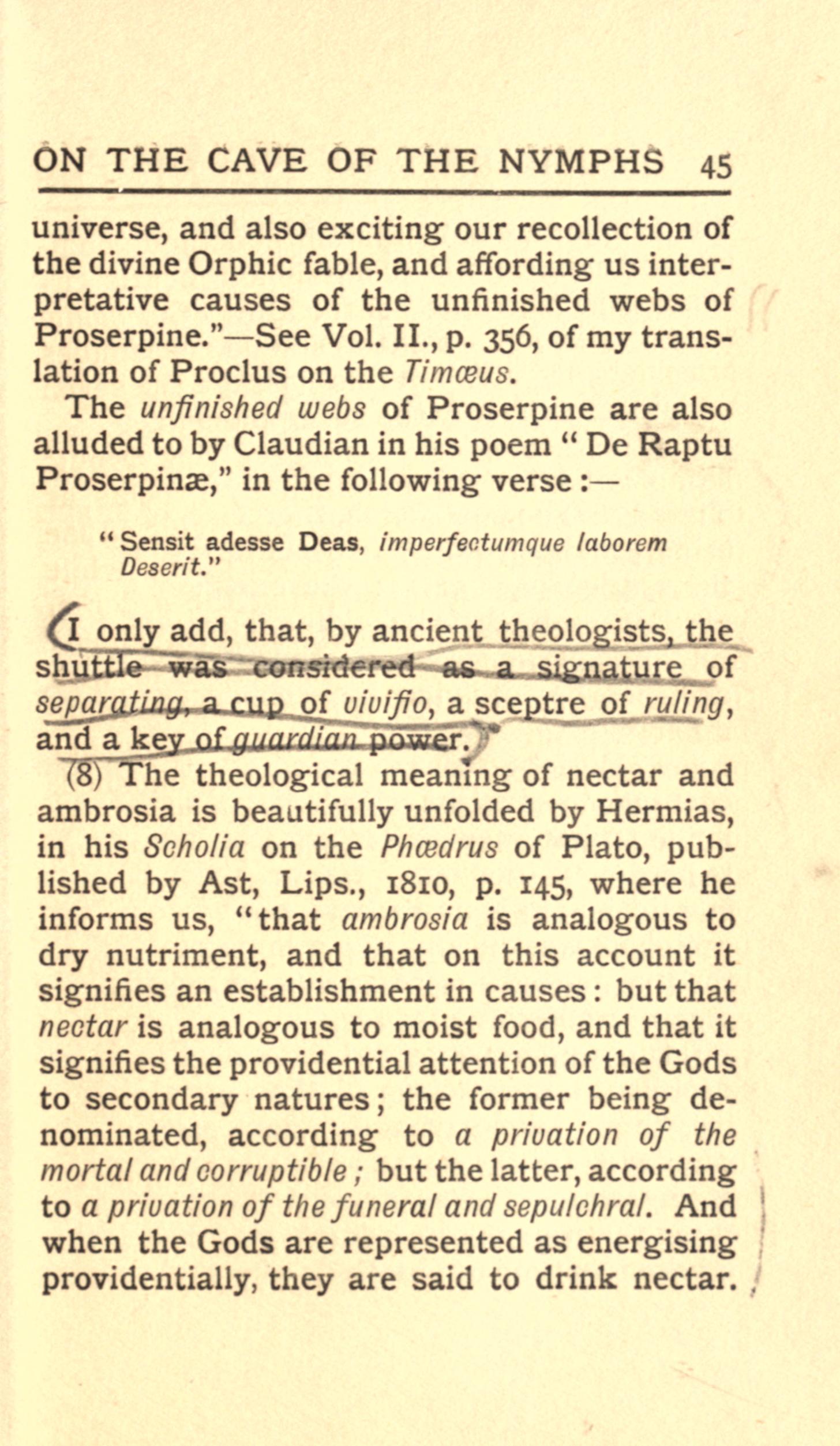
Shown small; open the link for the leaf at full size. The whole leaf is shown — it is the page image this reading was taken from, and no cropped detail is held.
- r0070OCRreading
life, the reward of severe life, the reward of severe → life, as the reward of severe
the print reads "in the athletic race of life, as the reward of severe toil" — the word "as" was lost. (decided by the transcription's own context.)
no witness · decided by the transcription's own context.
archive leaf n43
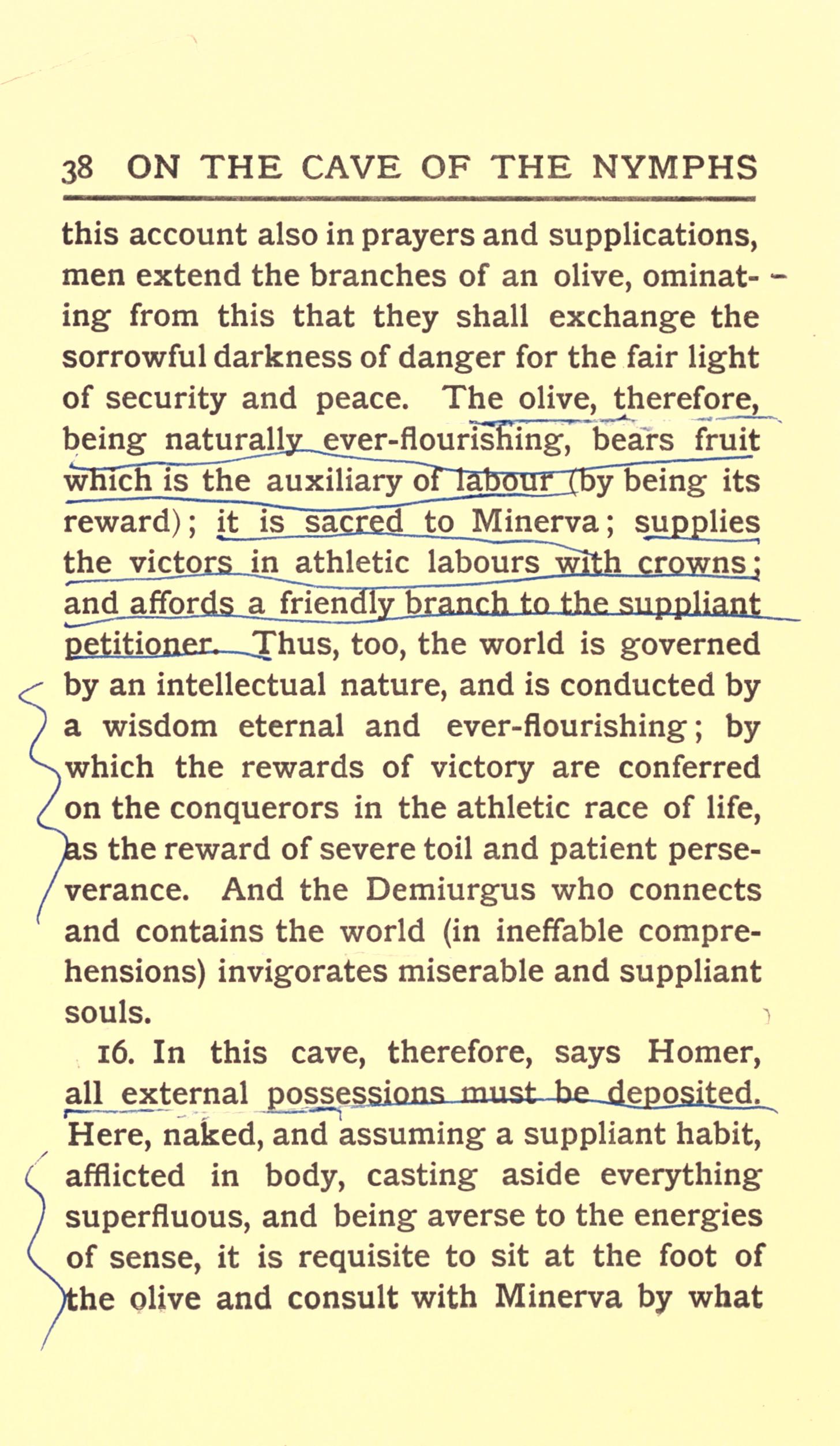
Shown small; open the link for the leaf at full size. The whole leaf is shown — it is the page image this reading was taken from, and no cropped detail is held.
- r0071OCRreading
sacred to soulis sacred to soulis → sacred to souls
the print reads "this cave was sacred to souls and aquatic nymphs" — 'soulis' is 'souls' misread. (decided by the transcription's own context.)
no witness · decided by the transcription's own context.
archive leaf n33 — the page image is cited here, but the leaf is not held with this edition.
- r0072OCRreading
Qypnf every virtue Qypnf every virtue → in an accurate knowledge of every virtue
the print reads "...intellectual prudence, and in an accurate knowledge of every virtue" (scan, printed page 41); the token carries a lost span, not a word. (decided by the transcription's own context.)
witness: printed page 41 · decided by the transcription's own context.
- r0073OCRreading
diuine diuine → divine
the 1917 print reads "more divine" (scan, printed page 54): the transcription's archaic-looking "diuine" is a scanner slip (u for v), not the print's spelling. (decided by the transcription's own context.)
witness: printed page 54 · decided by the transcription's own context.
- r0074OCRreading
Cloth, Svo. is. net. Post free is. 2d. Wrappers. 6d. net. Post free jd. Cloth, Svo. is. net. Post free is. 2d. Wrappers. 6d. net. Post free jd. → Cloth, 8vo. 1s. net. Post free 1s. 2d. Wrappers. 6d. net. Post free 7d.
Class 2: three substitutions without any damage character — 8 read as S ('Svo.'), 1 read as i twice ('is.'), and 7 read as j ('jd.' for '7d.'). (decided by the transcription's own context.)
no witness · decided by the transcription's own context.
- r0075OCRreading
Cloth, Svo. is. net. Post free is. 2d. Wrappers. 6d. net. Post free 7d. Cloth, Svo. is. net. Post free is. 2d. Wrappers. 6d. net. Post free 7d. → Cloth, 8vo. 1s. net. Post free 1s. 2d. Wrappers. 6d. net. Post free 7d.
Class 2: 8 read as S ('Svo.') and 1 read as i twice ('is.'); no damage character. (decided by the transcription's own context.)
no witness · decided by the transcription's own context.
- r0076OCRreading
Theobald Cloth, 8vo. Price is. net. Post free is. 2d. Theobald Cloth, 8vo. Price is. net. Post free is. 2d. → Theobald Cloth, 8vo. Price 1s. net. Post free 1s. 2d.
Class 2: numeral 1 read as letter i twice ('is.' for '1s.'); invisible to a damage-character census. (decided by the transcription's own context.)
no witness · decided by the transcription's own context.
- r0077OCRreading
Wrappers, Svo. Price 6d. net. Post free 7d. Wrappers, Svo. Price 6d. net. Post free 7d. → Wrappers, 8vo. Price 6d. net. Post free 7d.
Class 2: 'Svo.' for '8vo.' — numeral 8 read as S; no damage character. (decided by the transcription's own context.)
no witness · decided by the transcription's own context.
- r0078OCRreading
through the desire of generation, the soul through the desire of generation, the soul → through the desire of coition, the soul
A wrong English word carrying no damage character: the print reads 'coition', not 'generation' — the dangerous class invisible to any character census. (decided by the 1823 parallel.)
witness: 1823 parallel · decided by the 1823 parallel.
- r0079OCRreading
[l only add, that, by ancient theologists [l only add, that, by ancient theologists → [I only add, that, by ancient theologists
Class 2 — lower-case l substituted for the pronoun I at the head of the bracketed addition. (decided by the transcription's own context.)
no witness · decided by the transcription's own context.
- r0080punctuationreading
Orphic fiction "is beautifully unfolded Orphic fiction "is beautifully unfolded → Orphic fiction is beautifully unfolded
Class 1 — a spurious opening quotation-mark standing before 'is'; the quotation properly opens at 'Orpheus says' after 'as follows : '. (decided by the transcription's own context.)
no witness · differs only in punctuation characters: " (rule 3)
- r0081OCRreading
according to a priuation of the funeral according to a priuation of the funeral → according to a privation of the funeral
Class 2 — 'privation' with the v dropped, leaving the plausible non-word 'priuation'. (decided by the transcription's own context.)
no witness · decided by the transcription's own context.
- r0082OCRreading
Wrappers, Svo. Price 3d. Post free 4d. Wrappers, Svo. Price 3d. Post free 4d. → Wrappers, 8vo. Price 3d. Post free 4d.
Class 2: the numeral 8 of '8vo.' read as capital S ('Svo.'), a plausible-looking non-word with no damage character. (decided by the transcription's own context.)
no witness · decided by the transcription's own context.
- r0083OCRreading
Wrappers, Svo. Price 6d. Post free 7d. Wrappers, Svo. Price 6d. Post free 7d. → Wrappers, 8vo. Price 6d. Post free 7d.
Class 2: 'Svo.' for '8vo.' — numeral 8 read as S; no damage character. (decided by the transcription's own context.)
no witness · decided by the transcription's own context.
- r0084OCRreading
to call those that are married nymphs to call those that are married nymphs → to call these that are married nymphs
A single substituted English word with no damage character ('those' for the print's 'these'), invisible to the character count; the parallel, though a different printing, is clean here and decides. (decided by the 1823 parallel.)
witness: 1823 parallel · decided by the 1823 parallel.
- r0085OCRreading
Wrappers, Svo. 6d. net. Post free 7d. Wrappers, Svo. 6d. net. Post free 7d. → Wrappers, 8vo. 6d. net. Post free 7d.
Class 2: 'Svo.' for '8vo.' — numeral 8 read as S; no damage character. (decided by the transcription's own context.)
no witness · decided by the transcription's own context.
- r0086OCRreading
Price is. 6d. net. Post free is. yd. Price is. 6d. net. Post free is. yd. → Price 1s. 6d. net. Post free 1s. 7d.
Class 2: the shilling numeral 1 was read as the letter i in both 'is.', and the 7 of '7d.' as y ('yd.') — plausible-looking wrong words with no damage character. (decided by the transcription's own context.)
no witness · decided by the transcription's own context.
- r0087OCRreading
Price is. 6d. net. Post free is. 7d. Price is. 6d. net. Post free is. 7d. → Price 1s. 6d. net. Post free 1s. 7d.
Class 2: numeral 1 read as letter i twice ('is.' for '1s.'); no damage character anywhere in the words. (decided by the transcription's own context.)
no witness · decided by the transcription's own context.
- r0088OCRreading
to be liber ated from this sensible to be liber ated from this sensible → to be liberated from this sensible
Class 3 broken word: 'liberated' is split in two as 'liber ated' (the print's join or hyphen lost at the break) and the split is still shown to the reader of the published text. (decided by the transcription and the 1823 parallel.)
witness: 1823 parallel · before and after equal after removing all whitespace (rule 2)
- r0089OCRreading
then be liber ated from labours then be liber ated from labours → then be liberated from labours
Class 3 broken word: a second occurrence of 'liberated' split in two as 'liber ated', still visible in the reading view. (decided by the transcription and the 1823 parallel.)
witness: 1823 parallel · before and after equal after removing all whitespace (rule 2)
- r0090OCRreading
bowls, jhen, and the amphorae bowls, jhen, and the amphorae → bowls, then, and the amphorae
'then' misread 'jhen' (t for j) — a plausible-looking wrong word carrying no damage character, invisible to the character census; class 2. (decided by the transcription's own context.)
no witness · decided by the transcription's own context.
- r0091OCRreading
those instru ments pertaining those instru ments pertaining → those instruments pertaining
'instruments' split as 'instru ments' (dropped line-end hyphen); class 3. (decided by the transcription and the 1823 parallel.)
witness: 1823 parallel · before and after equal after removing all whitespace (rule 2)
- r0092OCRreading
these instru ments of weaving these instru ments of weaving → these instruments of weaving
Second occurrence of 'instruments' split as 'instru ments'; class 3. (decided by the transcription and the 1823 parallel.)
witness: 1823 parallel · before and after equal after removing all whitespace (rule 2)
- r0093OCRreading
and not of ^ any other matter and not of ^ any other matter → and not of any other matter
Caret standing alone between 'of' and 'any' where the print has only the word-space; class 1. (decided by the transcription and the 1823 parallel.)
witness: 1823 parallel · damage-set removal (rule 6)
- r0094OCRreading
tinged from nalood. and wool tinged from nalood. and wool → tinged from blood; and wool
'blood;' misread 'nalood.' (b for n, semicolon read as period) — a plausible-looking non-word with no damage character, census-blind; class 2. (decided by the transcription and the 1823 parallel.)
witness: 1823 parallel · decided by the transcription and the 1823 parallel.
- r0095OCRreading
heavens throught the influx heavens throught the influx → heavens through the influx
Class 2 — 'through' with its final h turned to t, leaving the plausible non-word 'throught'. (decided by the transcription's own context.)
no witness · decided by the transcription's own context.
- r0096OCRreading
Cui nautce septem germani Cui nautce septem germani → Cui nautæ septem germani
Class 2 — Latin 'nautæ' with the æ ligature read as 'ce'. (decided by the transcription's own context.)
no witness · decided by the transcription's own context.
- r0097OCRreading
webs will y evidently be webs will y evidently be → webs will evidently be
Stray 'y' artefact standing between 'will' and 'evidently' — not a damage-set character, so census-blind; class 1. (decided by the transcription and the 1823 parallel.)
witness: 1823 parallel · decided by the transcription and the 1823 parallel.
- r0098OCRreading
dyed from / animal juice dyed from / animal juice → dyed from animal juice
Slash (damage set) standing alone between 'from' and 'animal' — the print's space read as a symbol; class 1. (decided by the transcription and the 1823 parallel.)
witness: 1823 parallel · damage-set removal (rule 6)
- r0099punctuationreading
peculiarity . in ... the peculiarity . in ... the → peculiarity in the
Class 1 — a stray full stop and a dot-leader artefact stand in the reading view where the print carries plain spaces. (decided by the 1823 parallel.)
witness: 1823 parallel · differs only in punctuation characters: . (rule 3)
- r0100OCRreading
siirh nhgriirit;ifif::J siirh nhgriirit;ifif::J → such obscurities,
Run-together fragment in which 'such obscurities,' collapsed into noise with semicolon/colon artefacts and no damage-set character; class 2. (decided by the transcription and the 1823 parallel.)
witness: 1823 parallel · decided by the transcription and the 1823 parallel.
- r0101OCRreading
Pythagoreans. ancLafter Pythagoreans. ancLafter → Pythagoreans; and after
Class 3: 'and after' is fused into the run-together fragment 'ancLafter' (with d misread cL), and the full stop before it should be the parallel's semicolon — no damage character anywhere, so the census is blind. (decided by the transcription and the 1823 parallel.)
witness: 1823 parallel · decided by the transcription and the 1823 parallel.
- r0102OCRreading
woven from ^> the blood woven from ^> the blood → woven from the blood
'^>' standing alone before 'the blood' where the print has nothing but the space; class 1. (decided by the transcription and the 1823 parallel.)
witness: 1823 parallel · damage-set removal (rule 6)
- r0103OCRreading
inspective guar dian of inspective guar dian of → inspective guardian of
'guardian' split as 'guar dian' (dropped line-end hyphen); class 3. (decided by the transcription and the 1823 parallel.)
witness: 1823 parallel · before and after equal after removing all whitespace (rule 2)
- r0104OCRreading
an ex cess of moisture an ex cess of moisture → an excess of moisture
The printed word 'excess' is broken in two by a spurious space ('ex cess') with no damage character in it, so no rule fired and the census is blind to it — class 3. (decided by the transcription and the 1823 parallel.)
witness: 1823 parallel · before and after equal after removing all whitespace (rule 2)
- r0105OCRreading
essentially \4 darkand essentially \4 darkand → essentially dark and
A backslash (damage set) with a stray 4 stands in the reading view between 'essentially' and the word after it — very likely the print's own space read as a symbol (or a misread mark); the print reads 'essentially dark and obscure'; class 1. (decided by the transcription's own context.)
no witness · decided by the transcription's own context.
- r0106OCRreading
De Nuptiis Philologies De Nuptiis Philologies → De Nuptiis Philologiæ
Class 2 — Martianus Capella's title 'De Nuptiis Philologiæ', the ligature mangled to make a wrong Latin form 'Philologies'. (decided by the transcription's own context.)
no witness · decided by the transcription's own context.
- r0107OCRreading
connected., iThrough connected., iThrough → connected. Through
Class 1: stray ' , i' debris stands between the full stop and 'Through' in the reading view's own text. (The space before the comma is normalized away before the rules run.)
no witness · stray ‘ , i’ debris stands between the full stop and ‘Through’
- r0108OCRreading
dwell, near fountains dwell, near fountains → dwelt near fountains
Class 2: 'dwell' is a plausible real word substituted for the parallel's 'dwelt' (missing t), with a stray comma after it — invisible to any character census. (decided by the 1823 parallel.)
witness: 1823 parallel · decided by the 1823 parallel.
- r0109conjecturalreading
fountains and river; fountains and river; → fountains and rivers;
The plural 's' is missing from 'rivers' — a wrong word with no damage character, invisible to the census (class 2). (The space before the semicolon is normalized away before the rules run.)
no witness · The plural ‘s’ is missing from ‘rivers’
- r0110OCRreading
or Mithra. as well as or Mithra. as well as → For Mithra, as well as
'For' has lost its initial letter to become 'or', and Mithra's comma has been read as a period — wrong words carrying no damage character (class 2). (decided by the transcription's own context.)
no witness · decided by the transcription's own context.
- r0111OCRreading
is fhe, npminrgus and is fhe, npminrgus and → is the Demiurgus and
'the' mislettered as 'fhe' (the comma is scanner debris) and 'Demiurgus' — Taylor's standing rendering of δημιουργός — mislettered as 'npminrgus': substitution damage with no damage character (class 2). (decided by the transcription's own context.)
no witness · decided by the transcription's own context.
- r0112OCRreading
in stead of two gates in stead of two gates → instead of two gates
Word broken in two where the same word stands whole earlier in the sentence, class 3. (decided by the transcription and the 1823 parallel.)
witness: 1823 parallel · before and after equal after removing all whitespace (rule 2)
- r0113OCRreading
intelligible con cern intelligible con cern → intelligible concerns
Class 3 broken word: the word is split as 'con cern' and the final s is also lost, so the reading view shows two fragments where the print has one word; the parallel supplies 'concerns'. (decided by the transcription and the 1823 parallel.)
witness: 1823 parallel · decided by the transcription and the 1823 parallel.
- r0114OCRreading
described >by Proclus described >by Proclus → described by Proclus
Class 1 — the damage character '>' standing between 'described' and 'by', the print's own space read as a symbol; the reading is the space. (decided by the transcription's own context.)
no witness · damage-set removal (rule 6)
- r0115OCRreading
SUDDEN DEATH &THE WAR SUDDEN DEATH &THE WAR → SUDDEN DEATH & THE WAR
Class 3: two words fused — the space after the print's ampersand was lost, giving '&THE'. (decided by the transcription's own context.)
no witness · before and after equal after removing all whitespace (rule 2)
- r0116OCRreading
therefore, The world therefore, The world → therefore, the world
Class 2: wrong capital mid-sentence, a substituted letter no census can count. (decided by the transcription and the 1823 parallel.)
witness: 1823 parallel · decided by the transcription and the 1823 parallel.
- r0117OCRreading
rites per taining to rites per taining to → rites pertaining to
Class 3: 'pertaining' is broken in two by a spurious space in both the reading view and the transcription. (decided by the transcription's own context.)
no witness · before and after equal after removing all whitespace (rule 2)
- r0118OCRreading
have sus pected that have sus pected that → have suspected that
'suspected' split in two ('sus pected'), a line-end break whose hyphen the scanner dropped; class 3. (decided by the transcription's own context.)
no witness · before and after equal after removing all whitespace (rule 2)
- r0119OCRreading
souls that fail into souls that fail into → souls that fall into
Class 2: 'fail' is a wrong word for 'fall', invisible to any character census. (decided by the transcription and the 1823 parallel.)
witness: 1823 parallel · decided by the transcription and the 1823 parallel.
- r0120OCRreading
tmmHarjfi gfatnpnts tmmHarjfi gfatnpnts → mundane elements
Class 2: two garbled non-words carrying no damage-set character and therefore invisible to the census, left unrepaired in the reading view. (decided by the transcription and the 1823 parallel.)
witness: 1823 parallel · decided by the transcription and the 1823 parallel.
- r0121OCRreading
contents everywhere contents everywhere → contents every where
Class 3: 'every where' fused into 'everywhere'; the same section's print carries the word as two. (decided by the transcription's own context.)
no witness · before and after equal after removing all whitespace (rule 2)
- r0122punctuationreading
den For the powers den For the powers → den. For the powers
Class 2: a sentence-opening 'For' with no preceding stop — the print's period after 'den' is missing at the block seam. (decided by the 1823 parallel.)
witness: 1823 parallel · differs only in punctuation characters: . (rule 3)
- r0123OCRreading
\ But he is placed \ But he is placed → But he is placed
A lone backslash stands before the paragraph-initial 'But' — scanner debris for the paragraph opening (lost space/indent, possibly page-top furniture), still visible in the reading view (class 1); no separate reading is invented for the mark. (decided by the transcription's own context.)
no witness · damage-set removal (rule 6)
- r0124OCRreading
Charing Cross Read Charing Cross Read → Charing Cross Road
Class 2: a wrong real English word — 'oa' of 'Road' read as 'ea' ('Read'); no damage character. (decided by the transcription's own context.)
no witness · decided by the transcription's own context.
- r0125OCRreading
bottom i darkness bottom i darkness → bottom is darkness
Class 2: a missing s leaves the real English word 'i' — exactly the dangerous census-blind shape. (decided by the transcription and the 1823 parallel.)
witness: 1823 parallel · decided by the transcription and the 1823 parallel.
- r0126punctuationreading
JOHN M, W ATKINS, JOHN M, W ATKINS, → JOHN M. WATKINS,
Class 3: the surname is broken in two by a false space ('W ATKINS' for 'WATKINS'), with the period after the initial also misread as a comma ('M,'). (decided by the transcription's own context.)
no witness · differs only in punctuation characters: ,. (rule 3)
- r0127OCRreading
"noTTo sucn souls "noTTo sucn souls → world; for to such souls
Class 1 — several words collapsed into noise ('world; for to', with 'such' misread 'sucn') still standing in the reading view; the 1917's punctuation there is not separable from the noise. (decided by the 1823 parallel.)
witness: 1823 parallel · decided by the 1823 parallel.
- r0128OCRreading
mvsticallyplaces mvsticallyplaces → mystically places
Two words fused into one, with y additionally misread as v; class 3 fusion. (decided by the transcription and the 1823 parallel.)
witness: 1823 parallel · decided by the transcription and the 1823 parallel.
- r0129OCRreading
a passagetosouls a passagetosouls → a passage to souls
Class 3: three words fused into one ('passage to souls') with no damage character in the fused mass. (decided by the transcription's own context.)
no witness · before and after equal after removing all whitespace (rule 2)
- r0130OCRreading
arrexpTaHatiori arrexpTaHatiori → an explanation
Two words collapsed into a non-word artefact standing openly in the reading view with no damage character to flag it, class 1. (decided by the 1823 parallel.)
witness: 1823 parallel · decided by the 1823 parallel.
- r0131OCRreading
inter pretative inter pretative → interpretative
Class 3 — 'interpretative' broken across a print line, hyphen lost. (decided by the transcription's own context.)
no witness · before and after equal after removing all whitespace (rule 2)
- r0132punctuationreading
imperfec.tumque imperfec.tumque → imperfectumque
Class 1 — a stray full stop standing inside the Latin word 'imperfectumque' of Claudian's line. (decided by the transcription's own context.)
no witness · differs only in punctuation characters: . (rule 3)
- r0133OCRreading
situa tion situa tion → situation
'situation' split in two; class 3. (decided by the transcription and the 1823 parallel.)
witness: 1823 parallel · before and after equal after removing all whitespace (rule 2)
- r0134OCRreading
signi fication signi fication → signification
Class 3: 'signification' broken in two, census-blind. (decided by the transcription's own context.)
no witness · before and after equal after removing all whitespace (rule 2)
- r0135OCRreading
recesses doors recesses doors → recesses and trenches, caverns, doors
Whole printed words 'and trenches, caverns,' dropped between 'recesses' and 'doors' with no damage character anywhere in the surviving text, class 2 — invisible to the census. (decided by the 1823 parallel.)
witness: 1823 parallel · decided by the 1823 parallel.
- r0136OCRreading
that > hostile that > hostile → that hostile
A lone '>' stands between the words where the print carries only a space — the classic lost-space marker, still visible in the reading view (class 1). (decided by the transcription and the 1823 parallel.)
witness: 1823 parallel · damage-set removal (rule 6)
- r0137OCRreading
philo sophical philo sophical → philosophical
Class 3 — 'philosophical' broken across a print line, hyphen lost. (decided by the transcription's own context.)
no witness · before and after equal after removing all whitespace (rule 2)
- r0138OCRreading
distribu tion distribu tion → distribution
Class 3: 'distribution' broken in two, census-blind. (decided by the transcription and the 1823 parallel.)
witness: 1823 parallel · before and after equal after removing all whitespace (rule 2)
- r0139OCRreading
place \ which place \ which → place which
Class 1: '\' stands alone between words — the print's own space the scanner read as a symbol; give the space back. (decided by the transcription and the 1823 parallel.)
witness: 1823 parallel · damage-set removal (rule 6)
- r0140OCRreading
make a cavern make a cavern → take a cavern
Class 2, the dangerous class: 'make' is a plausible English word carrying no damage character, but the parallel prints 'take'. (decided by the 1823 parallel.)
witness: 1823 parallel · decided by the 1823 parallel.
- r0141punctuationreading
Naiades? from Naiades? from → Naiades from
Class 1: a stray question mark stands mid-declarative sentence where the print carries no mark — an artefact in the reading view's own text. (decided by the transcription and the 1823 parallel.)
witness: 1823 parallel · differs only in punctuation characters: ? (rule 3)
- r0142OCRreading
is y manifest is y manifest → is manifest
Class 1: a stray 'y' stands alone between 'is' and 'manifest' — an artefact the character census cannot count. (decided by the transcription and the 1823 parallel.)
witness: 1823 parallel · decided by the transcription and the 1823 parallel.
- r0143OCRreading
thepoetjralls thepoetjralls → the poet calls
'the poet calls' fused into one token with 'c' turned to 'jr', still standing whole in the reading view (class 3). (decided by the transcription and the 1823 parallel.)
witness: 1823 parallel · decided by the transcription and the 1823 parallel.
- r0144OCRreading
«*•<*, anH js «*•<*, anH js → , and is
Class 1 run-together fragment: the comma after 'taste' and the words 'and is' collapsed into scanner noise. The find leads with the SPACE the noise follows, so the replacement does not leave 'taste , and is' — the print sets the comma tight.
no witness · Class 1 run-together fragment: the comma after 'taste' and the words 'and is' co
- r0145OCRreading
putre faction putre faction → putrefaction
Class 3: 'putrefaction' broken in two and still shown split in the reading view, with no damage character to alert the census. (decided by the transcription's own context.)
no witness · before and after equal after removing all whitespace (rule 2)
- r0146OCRreading
trans cendent trans cendent → transcendent
Class 3 — 'transcendent' broken across a print line, hyphen lost. (decided by the transcription's own context.)
no witness · before and after equal after removing all whitespace (rule 2)
- r0147OCRreading
illumi nating illumi nating → illuminating
Class 3: line-break split with the hyphen lost. (decided by the transcription's own context.)
no witness · before and after equal after removing all whitespace (rule 2)
- r0148OCRreading
inte.llfrtnal inte.llfrtnal → intellectual
Class 1 — an OCR artefact standing in the reading view's own text whose characters (letters and full stops) fall outside the damage set, so the census is blind to it. (decided by the 1823 parallel.)
witness: 1823 parallel · decided by the 1823 parallel.
- r0149OCRreading
by / a wisdom by / a wisdom → by a wisdom
Class 1 — a slash marker stands alone between words in the reading view; it is the print's own space, read as a symbol — give the space. (decided by the transcription and the 1823 parallel.)
witness: 1823 parallel · damage-set removal (rule 6)
- r0150OCRreading
con secrated con secrated → consecrated
Class 3: 'consecrated' is broken in two by a lost line-break; neither half carries a damage character, so a character census cannot see it. (decided by the transcription's own context.)
no witness · before and after equal after removing all whitespace (rule 2)
- r0151punctuationreading
the ' Spirit the ' Spirit → the Spirit
A lone apostrophe stands between 'the' and 'Spirit' in the reading view — the print's own space read as a symbol (class 1). (decided by the transcription and the 1823 parallel.)
witness: 1823 parallel · differs only in punctuation characters: ' (rule 3)
- r0152OCRreading
terres trial terres trial → terrestrial
Class 3: 'terrestrial' is broken across the line break, the hyphen read as a space, leaving the spurious 'terres trial'. (decided by the transcription and the 1823 parallel.)
witness: 1823 parallel · before and after equal after removing all whitespace (rule 2)
- r0153OCRreading
fluctuat ing fluctuat ing → fluctuating
Class 3: 'fluctuating' is split in two by the line-end break, leaving 'fluctuat ing'. (decided by the transcription and the 1823 parallel.)
witness: 1823 parallel · before and after equal after removing all whitespace (rule 2)
- r0154OCRreading
cojisecrated cojisecrated → consecrated
Class 2: wrong word carrying no damage character ('n' read as 'ji'); the reading view still shows it wrong after the adjacent '_' on 'reality_' was repaired. (decided by the transcription and the 1823 parallel.)
witness: 1823 parallel · decided by the transcription and the 1823 parallel.
- r0155OCRreading
appella tion appella tion → appellation
Broken word: 'appellation' split in two (class 3). (decided by the transcription and the 1823 parallel.)
witness: 1823 parallel · before and after equal after removing all whitespace (rule 2)
- r0156OCRreading
con formably con formably → conformably
Word broken in two by a lost line-end hyphen, class 3; reading view still prints it as two words. (decided by the transcription and the 1823 parallel.)
witness: 1823 parallel · before and after equal after removing all whitespace (rule 2)
- r0157OCRreading
testi monies testi monies → testimonies
Word broken in two by a lost line-end hyphen, class 3. (decided by the transcription and the 1823 parallel.)
witness: 1823 parallel · before and after equal after removing all whitespace (rule 2)
- r0158OCRreading
trans lation trans lation → translation
Class 3 — 'translation' broken across a print line, hyphen lost. (decided by the transcription's own context.)
no witness · before and after equal after removing all whitespace (rule 2)
- r0159OCRreading
de nominated de nominated → denominated
Class 3 — 'denominated' broken across a print line, hyphen lost. (decided by the transcription's own context.)
no witness · before and after equal after removing all whitespace (rule 2)
- r0160OCRreading
repre sented repre sented → represented
Class 3 — 'represented' broken across a print line, hyphen lost. (decided by the transcription's own context.)
no witness · before and after equal after removing all whitespace (rule 2)
- r0161OCRreading
explana tion explana tion → explanation
Class 3: line-break split with the hyphen lost; the print reads 'explanation' as one word. (decided by the transcription's own context.)
no witness · before and after equal after removing all whitespace (rule 2)
- r0162OCRreading
intem perate intem perate → intemperate
Class 3: line-break split with the hyphen lost. (decided by the transcription's own context.)
no witness · before and after equal after removing all whitespace (rule 2)
- r0163OCRreading
separa tions separa tions → separations
Class 3: line-break split with the hyphen lost. (decided by the transcription's own context.)
no witness · before and after equal after removing all whitespace (rule 2)
- r0164OCRreading
gates omit a gates omit a → gates emit a
Class 2: 'omit' is a wrong English word with no damage character in it; the print reads 'emit'. (decided by the 1823 parallel.)
witness: 1823 parallel · decided by the 1823 parallel.
- r0165OCRreading
ex position ex position → exposition
'exposition' split in two; class 3. (decided by the transcription and the 1823 parallel.)
witness: 1823 parallel · before and after equal after removing all whitespace (rule 2)
- r0166punctuationreading
itself. and itself. and → itself, and
Class 2: a full stop before a lowercase 'and' — the print's comma misread as a period. (decided by the 1823 parallel.)
witness: 1823 parallel · differs only in punctuation characters: ., (rule 3)
- r0167OCRreading
simili tude simili tude → similitude
Class 3: 'similitude' is broken in two and left broken in the reading view. (decided by the transcription and the 1823 parallel.)
witness: 1823 parallel · before and after equal after removing all whitespace (rule 2)
- r0168OCRreading
re ceptacle re ceptacle → receptacle
Class 3: 'receptacle' is broken in two and left broken in the reading view. (decided by the transcription's own context.)
no witness · before and after equal after removing all whitespace (rule 2)
- r0169OCRreading
cavernwhich cavernwhich → cavern which
Class 3: 'cavern' and 'which' fused into one word; the reading view itself still prints 'a cavernwhich'. (decided by the transcription and the 1823 parallel.)
witness: 1823 parallel · before and after equal after removing all whitespace (rule 2)
- r0170OCRreading
con versant con versant → conversant
Class 3 — 'conversant' broken across a print line, the hyphen lost as a space. (decided by the transcription's own context.)
no witness · before and after equal after removing all whitespace (rule 2)
- r0171OCRreading
remark able remark able → remarkable
Class 3 — 'remarkable' broken across a print line, hyphen lost. (decided by the transcription's own context.)
no witness · before and after equal after removing all whitespace (rule 2)
- r0172OCRreading
Pythag oras Pythag oras → Pythagoras
Class 3 — 'Pythagoras' broken across a print line, hyphen lost. (decided by the transcription's own context.)
no witness · before and after equal after removing all whitespace (rule 2)
- r0173OCRreading
signify ing signify ing → signifying
Class 3 — 'signifying' broken across a print line, hyphen lost. (decided by the transcription's own context.)
no witness · before and after equal after removing all whitespace (rule 2)
- r0174OCRreading
per petuity per petuity → perpetuity
Class 3 — 'perpetuity' broken across a print line, hyphen lost. (decided by the transcription's own context.)
no witness · before and after equal after removing all whitespace (rule 2)
- r0175OCRreading
refine ment refine ment → refinement
Class 3 — 'refinement' broken across a print line, hyphen lost. (decided by the transcription's own context.)
no witness · before and after equal after removing all whitespace (rule 2)
- r0176OCRreading
insati able insati able → insatiable
Class 3: line-break split with the hyphen lost. (decided by the transcription's own context.)
no witness · before and after equal after removing all whitespace (rule 2)
- r0177OCRreading
Com mentary Com mentary → Commentary
Class 3: line-break split with the hyphen lost. (decided by the transcription's own context.)
no witness · before and after equal after removing all whitespace (rule 2)
- r0178OCRreading
per forated per forated → perforated
Class 3: line-break split with the hyphen lost (the same block has 'perforated' unsplit later). (decided by the transcription's own context.)
no witness · before and after equal after removing all whitespace (rule 2)
- r0179OCRreading
flpiirishes flpiirishes → flourishes
Class 1 — a garbled word of plain letters standing in the reading view for 'flourishes', invisible to any character census. (decided by the 1823 parallel.)
witness: 1823 parallel · decided by the 1823 parallel.
- r0180OCRreading
thejvictors thejvictors → the victors
Class 3 — 'the victors' fused into one word with a stray j standing for the space; no damage character. (decided by the transcription and the 1823 parallel.)
witness: 1823 parallel · decided by the transcription and the 1823 parallel.
- r0181OCRreading
some thing some thing → something
'something' split in two; class 3. (decided by the transcription and the 1823 parallel.)
witness: 1823 parallel · before and after equal after removing all whitespace (rule 2)
- r0182OCRreading
in tention in tention → intention
'intention' split in two; class 3. (decided by the transcription and the 1823 parallel.)
witness: 1823 parallel · before and after equal after removing all whitespace (rule 2)
- r0183punctuationreading
(Thus also (Thus also → Thus also
Class 1: an unmatched parenthesis, scanner debris, stands before 'Thus' in the reading view's text. (decided by the transcription and the 1823 parallel.)
witness: 1823 parallel · differs only in punctuation characters: ( (rule 3)
- r0184punctuationreading
too. Ceres too. Ceres → too, Ceres
Class 2: the comma after 'too' is misread as a period, splitting one clause into a fragment. (decided by the 1823 parallel.)
witness: 1823 parallel · differs only in punctuation characters: ., (rule 3)
- r0185punctuationreading
to' Nymphs to' Nymphs → to Nymphs
Class 1: a stray apostrophe artefact after 'to' (not in the damage set, invisible to the census); the parallel suggests it is the print's comma drifted from after 'Nymphs'. (decided by the transcription and the 1823 parallel.)
witness: 1823 parallel · differs only in punctuation characters: ' (rule 3)
- r0186OCRreading
cath artic cath artic → cathartic
Class 3: 'cathartic' broken in two with no damage character, invisible to the census. (decided by the transcription and the 1823 parallel.)
witness: 1823 parallel · before and after equal after removing all whitespace (rule 2)
- r0187OCRreading
per tain per tain → pertain
Broken word: 'pertain' split in two (class 3). (decided by the transcription's own context.)
no witness · before and after equal after removing all whitespace (rule 2)
- r0188OCRreading
in com mon in com mon → in common
Broken word: 'common' split in two (class 3). (decided by the transcription and the 1823 parallel.)
witness: 1823 parallel · before and after equal after removing all whitespace (rule 2)
- r0189OCRreading
gener ated gener ated → generated
Class 3 — 'generated' broken across a print line, hyphen lost. (decided by the transcription's own context.)
no witness · before and after equal after removing all whitespace (rule 2)
- r0190OCRreading
remind ing remind ing → reminding
Class 3 — 'reminding' broken across a print line, hyphen lost. (decided by the transcription's own context.)
no witness · before and after equal after removing all whitespace (rule 2)
- r0191OCRreading
pub lished pub lished → published
Class 3 — 'published' broken across a print line, hyphen lost. (decided by the transcription's own context.)
no witness · before and after equal after removing all whitespace (rule 2)
- r0192OCRreading
immu table immu table → immutable
Class 3 — 'immutable' broken across a print line, hyphen lost. (decided by the transcription's own context.)
no witness · before and after equal after removing all whitespace (rule 2)
- r0193OCRreading
know ledge know ledge → knowledge
Class 3 — 'knowledge' broken across a print line, hyphen lost. (decided by the transcription's own context.)
no witness · before and after equal after removing all whitespace (rule 2)
- r0194OCRreading
con tinued con tinued → continued
Class 3 — 'continued' broken across a print line, hyphen lost. (decided by the transcription's own context.)
no witness · before and after equal after removing all whitespace (rule 2)
- r0195OCRreading
rudi ments rudi ments → rudiments
Class 3 — 'rudiments' broken across a print line, hyphen lost. (decided by the transcription's own context.)
no witness · before and after equal after removing all whitespace (rule 2)
- r0196OCRreading
gen erated gen erated → generated
Class 3 — 'generated' broken across a print line, hyphen lost. (decided by the transcription's own context.)
no witness · before and after equal after removing all whitespace (rule 2)
- r0197OCRreading
impetu ous impetu ous → impetuous
Class 3 — 'impetuous' broken across a print line, hyphen lost. (decided by the transcription's own context.)
no witness · before and after equal after removing all whitespace (rule 2)
- r0198OCRreading
per ceives per ceives → perceives
Class 3 — 'perceives' broken across a print line, hyphen lost. (decided by the transcription's own context.)
no witness · before and after equal after removing all whitespace (rule 2)
- r0199OCRreading
propitipus propitipus → propitious
Class 2: a non-word with no damage mark in it, invisible to a character census; the print reads 'propitious'. (decided by the transcription's own context.)
no witness · decided by the transcription's own context.
- r0200OCRreading
pos sessed pos sessed → possessed
Class 3: the word is broken at the print's line break and the hyphen was lost in flattening. (decided by the transcription's own context.)
no witness · before and after equal after removing all whitespace (rule 2)
- r0201OCRreading
narra tion narra tion → narration
Class 3: line-break split with the hyphen lost. (decided by the transcription's own context.)
no witness · before and after equal after removing all whitespace (rule 2)
- r0202OCRreading
signi fied signi fied → signified
Class 3: line-break split with the hyphen lost (the same block already carries 'signified' unsplit, confirming the print's word). (decided by the transcription's own context.)
no witness · before and after equal after removing all whitespace (rule 2)
- r0203OCRreading
Euri pides Euri pides → Euripides
Class 3: line-break split with the hyphen lost (note 23 above carries 'Euripides' unsplit). (decided by the transcription's own context.)
no witness · before and after equal after removing all whitespace (rule 2)
- r0204OCRreading
the eartju the eartju → the earth
Class 2: 'earth' with the final 'h' misread as 'ju' — a wrong word carrying no damage character. (decided by the transcription's own context.)
no witness · decided by the transcription's own context.
- r0205OCRreading
dark ness dark ness → darkness
'darkness' split in two; class 3, confirmed whole in the parallel printing. (decided by the transcription and the 1823 parallel.)
witness: 1823 parallel · before and after equal after removing all whitespace (rule 2)
- r0206OCRreading
ZoTbaster ZoTbaster → Zoroaster
Class 2: 'Zoroaster' garbled by substituted letters with no damage character, still shown in the reading view. (decided by the transcription and the 1823 parallel.)
witness: 1823 parallel · decided by the transcription and the 1823 parallel.
- r0207OCRreading
pre side. pre side. → preside.
Class 3: 'preside' is broken in two ('pre side') and left so in the reading view. (decided by the transcription and the 1823 parallel.)
witness: 1823 parallel · before and after equal after removing all whitespace (rule 2)
- r0208OCRreading
dwell ing dwell ing → dwelling
Class 3: 'dwelling' is broken in two and left broken in the reading view. (decided by the transcription and the 1823 parallel.)
witness: 1823 parallel · before and after equal after removing all whitespace (rule 2)
- r0209OCRreading
con sists con sists → consists
Class 3: 'consists' broken in two with no damage character anywhere, still shown split in the reading view. (decided by the transcription and the 1823 parallel.)
witness: 1823 parallel · before and after equal after removing all whitespace (rule 2)
- r0210OCRreading
like wise like wise → likewise
Class 3: 'likewise' broken in two with no damage character. (decided by the transcription and the 1823 parallel.)
witness: 1823 parallel · before and after equal after removing all whitespace (rule 2)
- r0211OCRreading
pre sides pre sides → presides
Class 3: the word 'presides' is broken in two by the print's line-end break, which the scanner read as a space. (decided by the transcription's own context.)
no witness · before and after equal after removing all whitespace (rule 2)
- r0212OCRreading
situ ated situ ated → situated
Class 3: 'situated' broken in two by a false space; the reading view still carries the break. (decided by the transcription and the 1823 parallel.)
witness: 1823 parallel · before and after equal after removing all whitespace (rule 2)
- r0213OCRreading
Dedicated Dedicated → dedicated
A capital D substituted mid-sentence in 'are not Dedicated' — a wrong word carrying no damage character (class 2). (decided by the transcription and the 1823 parallel.)
witness: 1823 parallel · decided by the transcription and the 1823 parallel.
- r0214OCRreading
the 7 sea the 7 sea → the sea
Class 1 visible artefact: a stray digit 7 stands alone between 'the' and 'sea' in the reading view's own text — scanner debris standing where the print carries only the space between the two words, so the print reads 'the sea' (if the 1917 print should carry a footnote numeral at this spot a human must retain it). (decided by the transcription's own context.)
no witness · decided by the transcription's own context.
- r0215OCRreading
sen sible sen sible → sensible
Class 3 — 'sensible' broken across a print line, hyphen lost. (decided by the transcription's own context.)
no witness · before and after equal after removing all whitespace (rule 2)
- r0216OCRreading
physi cal physi cal → physical
Class 3: line-break split with the hyphen lost. (decided by the transcription's own context.)
no witness · before and after equal after removing all whitespace (rule 2)
- r0217OCRreading
pro bable pro bable → probable
Class 3: line-break split with the hyphen lost. (decided by the transcription's own context.)
no witness · before and after equal after removing all whitespace (rule 2)
- r0218OCRreading
par takes par takes → partakes
Class 3: line-break split with the hyphen lost. (decided by the transcription's own context.)
no witness · before and after equal after removing all whitespace (rule 2)
- r0219OCRreading
cavi ties cavi ties → cavities
Class 3: line-break split with the hyphen lost. (decided by the transcription's own context.)
no witness · before and after equal after removing all whitespace (rule 2)
- r0220OCRreading
evi dent evi dent → evident
'evident' is broken in two by a flattened line break the print does not carry as a space; class 3. (decided by the transcription's own context.)
no witness · before and after equal after removing all whitespace (rule 2)
- r0221OCRreading
essenceT essenceT → essence.
Capital T substituted for the sentence's full stop — a wrong character with no damage marker, and the reading view still shows 'essenceT' (class 2). (decided by the transcription's own context.)
no witness · decided by the transcription's own context.
- r0222OCRreading
whichare whichare → which are
'which are' fused into one word with no damage character, invisible to the census (class 3). (decided by the transcription and the 1823 parallel.)
witness: 1823 parallel · before and after equal after removing all whitespace (rule 2)
- r0223OCRreading
soulsi f soulsi f → souls
Debris 'i f' clinging to 'souls' still stands in the reading view, where the print reads simply 'souls' (class 1). (decided by the transcription and the 1823 parallel.)
witness: 1823 parallel · decided by the transcription and the 1823 parallel.
- r0224punctuationreading
water) . water) . → water
A closing parenthesis and full stop stand as debris after 'water' in the reading view, where the print runs straight on to 'is the nutriment' (class 1). (decided by the transcription and the 1823 parallel.)
witness: 1823 parallel · differs only in punctuation characters: ). (rule 3)
- r0225OCRreading
how ever how ever → however
Class 3: 'however' is split in two by the line-end break the scanner read as a space. (decided by the transcription and the 1823 parallel.)
witness: 1823 parallel · before and after equal after removing all whitespace (rule 2)
- r0226OCRreading
imagelmd imagelmd → image and
Class 3: 'image' and 'and' fused with letter noise ('lmd' for 'and'), still shown fused in the reading view. (decided by the transcription and the 1823 parallel.)
witness: 1823 parallel · decided by the transcription and the 1823 parallel.
- r0227punctuationreading
man. who man. who → man, who
The print's comma after 'man' was read as a full stop — a substitution invisible to any damage-character census (class 2); the recorded reading repaired 'us^a_man' but left the period wrong. (decided by the 1823 parallel.)
witness: 1823 parallel · differs only in punctuation characters: ., (rule 3)
- r0228OCRreading
mean ing mean ing → meaning
'meaning' broken in two by a spurious space, carried unchanged into the reading view — class 3. (decided by the 1823 parallel.)
witness: 1823 parallel · before and after equal after removing all whitespace (rule 2)
- r0229OCRreading
de rived de rived → derived
Class 3 — 'derived' broken across a print line, hyphen lost. (decided by the transcription's own context.)
no witness · before and after equal after removing all whitespace (rule 2)
- r0230OCRreading
her self her self → herself
Class 3 — 'herself' broken at a print line-end within a block that shows several line breaks (same lost-hyphen damage as 'signify ing' and 'impetu ous' here). (decided by the transcription's own context.)
no witness · before and after equal after removing all whitespace (rule 2)
- r0231OCRreading
givingjt givingjt → giving it
Class 3 — 'giving it' fused into one word, the space and initial i collapsing to a j, with no damage character for the census to see. (decided by the transcription and the 1823 parallel.)
witness: 1823 parallel · decided by the transcription and the 1823 parallel.
- r0232OCRreading
yngrtnmj yngrtnmj → wisdom
Class 1 — a garbled word standing in the reading view for 'wisdom' (the print's following comma was lost with the noise). (decided by the 1823 parallel.)
witness: 1823 parallel · decided by the 1823 parallel.
- r0233punctuationreading
.Minerva .Minerva → Minerva
Class 1 — a stray full stop at the head of the block stands in the reading view where the lost word 'and' belongs; page-boundary debris, not the print's. (decided by the 1823 parallel.)
witness: 1823 parallel · differs only in punctuation characters: . (rule 3)
- r0234punctuationreading
wisdom?. wisdom?. → wisdom.
Class 2 — a question mark substituted for the print's full stop, carrying no damage character and so invisible to the census. (decided by the 1823 parallel.)
witness: 1823 parallel · differs only in punctuation characters: ? (rule 3)
- r0235OCRreading
thecaye thecaye → the cave
'the cave' fused into one word with c misread as y; class 3 fusion. (decided by the transcription and the 1823 parallel.)
witness: 1823 parallel · decided by the transcription and the 1823 parallel.
- r0236OCRreading
un fold un fold → unfold
'unfold' split in two; class 3. (decided by the transcription and the 1823 parallel.)
witness: 1823 parallel · before and after equal after removing all whitespace (rule 2)
- r0237punctuationreading
me. the me. the → me, the
Class 2: a full stop before lowercase 'the' — the print's comma after 'me' misread as a period. (decided by the 1823 parallel.)
witness: 1823 parallel · differs only in punctuation characters: ., (rule 3)
- r0238punctuationreading
denlike denlike → den-like
Class 2: the plausible-looking non-word 'denlike' — the print's hyphen in 'den-like' is missing. (decided by the transcription and the 1823 parallel.)
witness: 1823 parallel · differs only in punctuation characters: - (rule 3)
- r0239punctuationreading
For" in For" in → For in
A stray quotation mark stands in the reading view between 'For' and 'in consequence' where the print has the space; this printing sets no comma after 'For' ('For they', 'For we', 'For the ancients') (class 1). (decided by the transcription's own context.)
no witness · differs only in punctuation characters: " (rule 3)
- r0240OCRreading
thejiL. thejiL. → them.
'them.' garbled to 'thejiL.' carrying no damage character — census-blind and still shown unrepaired in the reading view (class 2). (decided by the 1823 parallel.)
witness: 1823 parallel · decided by the 1823 parallel.
- r0241OCRreading
smiTfi. smiTfi. → south.
'south.' garbled to 'smiTfi.' with no damage character anywhere in it — a census-blind wrong word standing in the reading view (class 2). (decided by the 1823 parallel.)
witness: 1823 parallel · decided by the 1823 parallel.
- r0242OCRreading
fiealso fiealso → He also
Two print words, 'He also', fused into one token (with the H additionally misread) — a census-blind fusion the character count cannot see (class 3). (decided by the 1823 parallel.)
witness: 1823 parallel · decided by the 1823 parallel.
- r0243OCRreading
nymphsT nymphsT → nymphs.
A capital T fused to 'nymphs' where the print's sentence full-stop stands (the next paragraph opens 'But these places') — a wrong word with no damage character (class 2). (decided by the transcription's own context.)
no witness · decided by the transcription's own context.
- r0244OCRreading
retains retains → detains
Wrong word carrying no damage character — d read as r; the parallel printing cleanly reads 'detains'; class 2. (decided by the 1823 parallel.)
witness: 1823 parallel · decided by the 1823 parallel.
- r0245OCRreading
In deed In deed → Indeed
The single word 'Indeed' is broken in two by a spurious space, with no damage character anywhere (class 3). (decided by the 1823 parallel.)
witness: 1823 parallel · before and after equal after removing all whitespace (rule 2)
- r0246OCRreading
rpannpr rpannpr → manner
A plausible-looking non-word standing for 'manner' with no damage character in it — the dangerous census-invisible class (class 2). (decided by the transcription and the 1823 parallel.)
witness: 1823 parallel · decided by the transcription and the 1823 parallel.
- r0247OCRreading
oi tne waters oi tne waters → of the waters
the print reads "on account of the unputrescent nature of the waters" (the 1917 scan, printed page 23; and the 1823 parallel). The rule this replaces read "i tne w" -> "i the w", a HALF repair that left "oi" standing and rendered "oi the waters".
witness: 1823 parallel; 1917 scan, printed page 23 · the print reads "on account of the unputrescent nature of the waters"
- r0248OCRreading
nearthe nearthe → near the
Class 3 — 'near the' fused into one word with no damage character anywhere in it. (decided by the 1823 parallel.)
witness: 1823 parallel · before and after equal after removing all whitespace (rule 2)
- r0249punctuationreading
crowns- crowns- → crowns;
Class 2 — a line-break hyphen stands in the reading view where the print closes the clause with a semicolon; no damage character. (decided by the 1823 parallel.)
witness: 1823 parallel · differs only in punctuation characters: -; (rule 3)
- r0250OCRreading
Jlence Jlence → Hence
H misread as J — a wrong word carrying no damage character; class 2. (decided by the transcription and the 1823 parallel.)
witness: 1823 parallel · decided by the transcription and the 1823 parallel.
- r0251punctuationreading
form.. form.. → form.
Class 1: a doubled full stop is an artefact still standing in the reading view's text where the print carries one period. (decided by the transcription's own context.)
no witness · differs only in punctuation characters: . (rule 3)
- r0252OCRreading
caveni caveni → cavern
Class 2: 'cavern' misread as the plausible-looking non-word 'caveni' (r as i), no damage character present. (decided by the transcription's own context.)
no witness · decided by the transcription's own context.
- r0253OCRreading
rpmntq rpmntq → remote
OCR garbage standing for 'remote' with no damage-set character, so the character census never counts it — a wrong word still standing in the reading view (class 2). (decided by the 1823 parallel.)
witness: 1823 parallel · decided by the 1823 parallel.
- r0254OCRreading
(v. n) (v. n) → (v. 11)
Class 2: no damage mark, but 'n' is not a letter here — it is the scanner's joining of '11', the verse number of the print's citation. (decided by the transcription's own context.)
no witness · decided by the transcription's own context.
- r0255OCRreading
CEneus CEneus → Œneus
Class 2: the print's ligature Œ was read as 'CE', leaving the name 'CEneus' — a plausible-looking wrong form carrying no damage character. (decided by the transcription's own context.)
no witness · decided by the transcription's own context.
- r0256OCRreading
t-hi.c t-hi.c → this
Class 1 — a garbled fragment standing in the reading view for the print's 'this', carrying no damage-set character. (decided by the 1823 parallel.)
witness: 1823 parallel · decided by the 1823 parallel.
- r0257OCRreading
jwhich jwhich → which
Class 2 — a substituted letter (j for w) leaves a plausible-looking non-word with no damage character, still standing in the reading view. (decided by the 1823 parallel.)
witness: 1823 parallel · decided by the 1823 parallel.
- r0258OCRreading
ooetT ooetT → poet,
'poet' garbled to 'ooet' with a stray T artefact (the print's comma) standing in the reading view's text; class 1 artefact. (decided by the transcription and the 1823 parallel.)
witness: 1823 parallel · decided by the transcription and the 1823 parallel.
- r0259OCRreading
tfiem tfiem → them
Class 2: 'them' misread as the non-word 'tfiem', carrying no damage character. (decided by the transcription's own context.)
no witness · decided by the transcription's own context.
- r0260OCRreading
jwjth jwjth → with
Class 2: a mis-scanned 'with' (j for i) carrying no damage character, still standing in the reading view as a non-word the census cannot see. (decided by the transcription and the 1823 parallel.)
witness: 1823 parallel · decided by the transcription and the 1823 parallel.
- r0261OCRreading
morel morel → more
'morel' is a real-looking wrong word standing where the print has 'more', with no damage character — class 2, the census-blind class. (decided by the 1823 parallel.)
witness: 1823 parallel · decided by the 1823 parallel.
- r0262OCRreading
nlivp nlivp → olive
Class 1 — a garbled word standing in the reading view for 'olive'; the damage around it was repaired but this word, holding no damage-set character, was left. (decided by the 1823 parallel.)
witness: 1823 parallel · decided by the 1823 parallel.
- r0263OCRreading
Jeing Jeing → being
Class 2 — a capital J substituted for b leaves a plausible-looking non-word with no damage character (the dash before it may be this print's own). (decided by the 1823 parallel.)
witness: 1823 parallel · decided by the 1823 parallel.
- r0264OCRreading
' jHj ' jHj → an
Class 1 — a run-together fragment standing in the reading view for the print's 'an', none of its characters in the damage set. (decided by the 1823 parallel.)
witness: 1823 parallel · decided by the 1823 parallel.
- r0265OCRreading
Ivith Ivith → with
Class 2 — a capital I substituted for w leaves a plausible-looking non-word with no damage character. (decided by the 1823 parallel.)
witness: 1823 parallel · decided by the 1823 parallel.
- r0266OCRreading
QYfT QYfT → over
The word 'over' corrupted to the non-word 'QYfT' with no damage-set character, invisible to the census (class 2). (decided by the transcription and the 1823 parallel.)
witness: 1823 parallel · decided by the transcription and the 1823 parallel.
- r0267OCRreading
thff thff → the dark and stormy sea
'thff' is a corruption of 'the' carrying no damage marker, and the print's following words 'dark and stormy sea' were dropped entirely between it and the next block's 'of generation' — silent word-loss wholly invisible to the character count (class 2). (decided by the transcription and the 1823 parallel.)
witness: 1823 parallel · decided by the transcription and the 1823 parallel.
- r0268OCRreading
she^ she^ → she
Class 1: a '^' damage mark still standing at the end of the word in the reading view, most likely debris of the lost line-end hyphen or scanner noise; the printed word is simply 'she'. (decided by the transcription's own context.)
no witness · damage-set removal (rule 6)
- r0269OCRreading
fby fby → (by
Class 2 — a stray letter f stands where the print opens its parenthetical insertion (this printing parenthesises its insertions, as '(i.e.' and the surviving ')' after 'essence' show). (decided by the transcription and the 1823 parallel.)
witness: 1823 parallel · decided by the transcription and the 1823 parallel.
archive leaf n42
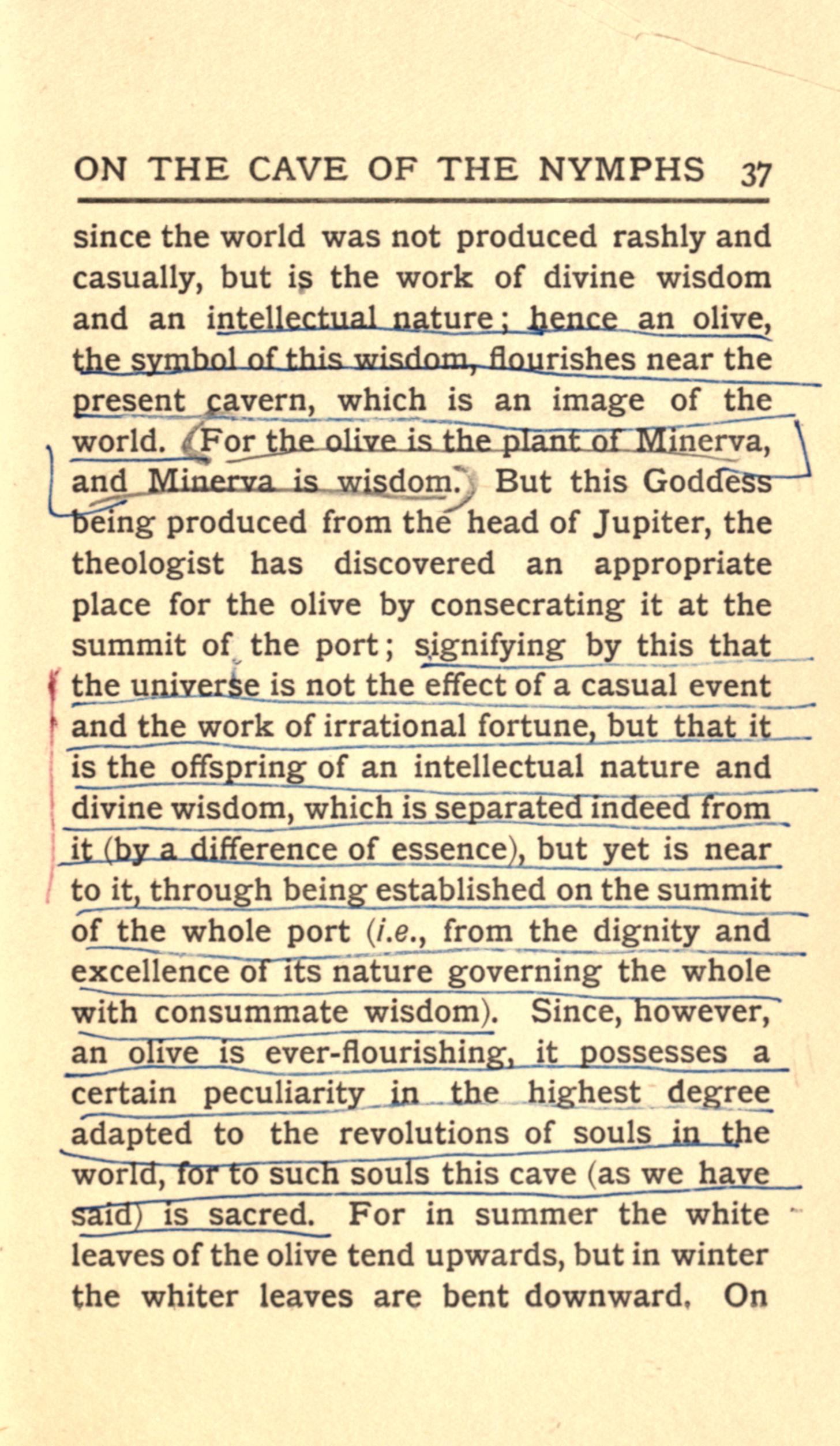
Shown small; open the link for the leaf at full size. The whole leaf is shown — it is the page image this reading was taken from, and no cropped detail is held.
- r0270OCRreading
hf> hf> → be
the print reads "hf>"->"be" ("it would be absurd for"): the transcription's own sentence
no witness · the print reads "hf>"->"be"
- r0271OCRreading
in_d^scfi5mga in_d^scfi5mga → in describing a
the print reads "in describing a" (the transcription's own words "in_d^scfi5mga cave fabricated")
no witness · the print reads "in describing a"
- r0272OCRreading
^jnerely ^jnerely → merely
the print reads "merely" (the transcription's own words "^jnerely by poetical license")
no witness · the print reads "merely"
- r0273OCRreading
that_jg_the that_jg_the → that is the
the 1823 parallel reads "and that is the symbol of the olive planted at the top of the cavern". Placed BEFORE the general "_the" -> "the" rule, which would otherwise consume the same characters and render "that_jgthe" — a non-word. A general rule cannot see that the marker here stands for a whole word.
witness: 1823 parallel · 1823 parallel reads "and that is the symbol of the olive plante
- r0274OCRreading
_the _the → the
stray marker at the word's edge; the printed word is exactly the letters present, "the"
no witness · damage-set removal (rule 6)
- r0275OCRreading
Thp_anrt'p'rii'c: Thp_anrt'p'rii'c: → The ancients
the print reads "The ancients, indeed, very properly consecrated a cave to the world" (the 1823 parallel edition:8667,8680); the transcription's own comma after the colon supplies the first comma, and the machine proposal "The Pythagoreans, and after them Plato," is another sentence
witness: 1823 parallel; parallel edition · the print reads "The ancients, indeed, very properly consecrated a cave to the world"
- r0276OCRreading
v^ry v^ry → very
the print reads "very" (the 1823 parallel edition:8667+)
witness: 1823 parallel; parallel edition · the print reads "very"
- r0277OCRreading
jQhe^ajricients jQhe^ajricients → the ancients
the print reads "the ancients"
no witness · the print reads "the ancients"
- r0278OCRreading
obscurity_o£ obscurity_o£ → obscurity of
the print reads "obscurity of"
no witness · the print reads "obscurity of"
- r0279OCRreading
the_cavern». the_cavern». → the cavern,
the print reads "obscurity of the cavern, were considered by the ancients" (the 1823 parallel, and the 1917 scan, printed page 10): the » is a misread comma and the transcription's full stop is the same mark. The earlier reading left a ".", rendering "the cavern,." .
witness: 1823 parallel; 1917 scan, printed page 10 · damage-set removal (rule 6)
- r0280OCRreading
qreneratioi^and qreneratioi^and → generation, and
the print reads "generation, and"; this find is unique to its site, where the shorter "^and" glued two printed words
no witness · the print reads "generation, and"
- r0281OCRreading
obscure .^and obscure .^and → obscure, (and
the "." is the comma and the "^" the opening parenthesis of Taylor's aside: the 1823 parallel reads "parts are obscure, [and its very bottom is darkness itself]." (:8727), and this edition sets that aside as a parenthesis — its own close stands as the literal ") ." three lines below. The print reads "obscure, (and"; the earlier "obscure, and" dropped the bracket.
witness: 1823 parallel · damage-set removal (rule 6)
- r0282OCRreading
Persians,^ Persians,^ → Persians,
stray marker at the word's edge; the printed word is "Persians,"
no witness · damage-set removal (rule 6)
- r0283OCRreading
regions^ regions^ → regions,
the marker stands at the word's edge where the 1823 parallel reads "into the sublunary regions, and its regression" (:8729); the print has the comma, so the reading keeps it. (Was recorded "regions", dropping a mark the parallel shows — the same shape the same file records as "Caves," for "Cayes^" and "Gods," for "Gods7".
witness: 1823 parallel · damage-set removal (rule 6)
- r0284OCRreading
rites} rites} → rites)
the } is an unreadable BRACKET: the 1823 parallel reads "the arcane sacred rites] in a place" (:8731), and this edition sets Taylor's brackets as parentheses (the run's own OPENING bracket stands as a literal "(" earlier in the same sentence, and "darkness itself)." closes the same construction above). The print has the closing bracket; the reading keeps it as ")".
witness: 1823 parallel · damage-set removal (rule 6)
- r0285OCRreading
fabric^tSdJfcUUMitb£a'y fabric^tSdJfcUUMitb£a'y → fabricated by Mithra.
the print reads "fabricated by Mithra."
no witness · the print reads "fabricated by Mithra."
- r0286OCRreading
t*16 t*16 → the
the print reads "the" ("But the things contained in the cavern")
no witness · the print reads "the"
- r0287OCRreading
oL^he oL^he → of the
the print reads "of the"
no witness · the print reads "of the"
- r0288OCRreading
«ffma±es.^ «ffma±es.^ → climates.
the print reads "climates." (the 1823 parallel edition:8745, "symbols of the mundane elements and climates"); the proposal "powers" is wrong
witness: 1823 parallel; parallel edition · the print reads "climates."
- r0289OCRreading
y^Nfpt y^Nfpt → Not
the print reads "Not" ("Not only, however, did the ancients")
no witness · the print reads "Not"
- r0290OCRreading
n^rom n^rom → From
the print reads "From"
no witness · the print reads "From"
- r0291OCRreading
a^den a^den → a den
the print reads "a den"
no witness · damage-set removal (rule 6)
- r0292OCRreading
leUcfers'^f leUcfers'^f → leaders of
the print reads "leaders of"
no witness · the print reads "leaders of"
- r0293OCRreading
cavern* cavern* → caverns
BLOCKER: the print reads "caverns" ("because caverns are dark, stony, and humid", the 1823 parallel edition:8823)
witness: 1823 parallel; parallel edition · the print reads "caverns"
- r0294OCRreading
j>fjyhich j>fjyhich → of which
the print reads "of which"
no witness · the print reads "of which"
- r0295OCRreading
cave^ cave^ → cave
stray marker at the word's edge; the printed word is "cave"
no witness · damage-set removal (rule 6)
- r0296OCRreading
be~assumed be~assumed → be assumed
the print reads "be assumed"
no witness · damage-set removal (rule 6)
- r0297OCRreading
Eox_we_p_eculiarly Eox_we_p_eculiarly → For we peculiarly
the print reads "For we peculiarly" (the 1823 parallel edition:8849)
witness: 1823 parallel; parallel edition · the print reads "For we peculiarly"
- r0298OCRreading
the_jMowers the_jMowers → the powers
the print reads "the powers" (the 1823 parallel edition:8849); NOT "the flowers"
witness: 1823 parallel; parallel edition · the print reads "the powers"
- r0299OCRreading
pver^wajters pver^wajters → over waters
the print reads "over waters" (the 1823 parallel edition:8849)
witness: 1823 parallel; parallel edition · the print reads "over waters"
- r0300OCRreading
Nyjnph^ Nyjnph^ → Nymphs;
the print reads "Nymphs; and this term also" (the 1823 parallel edition:8849+)
witness: 1823 parallel; parallel edition · the print reads "Nymphs
- r0301OCRreading
this^erm_also this^erm_also → this term also
the print reads "this term also"
no witness · the print reads "this term also"
- r0302OCRreading
souls_wjio_have souls_wjio_have → souls who have
the print reads "souls who have"
no witness · the print reads "souls who have"
- r0303OCRreading
air.^ air.^ → air.
stray marker at the word's edge; the printed word is "air."
no witness · damage-set removal (rule 6)
- r0304OCRreading
aguatic~nymipEsi aguatic~nymipEsi → aquatic nymphs
the print reads "aquatic nymphs"
no witness · the print reads "aquatic nymphs"
- r0305OCRreading
p\irple p\irple → purple
the print reads "purple"
no witness · the print reads "purple"
- r0306OCRreading
h_qney_combs_?__ h_qney_combs_?__ → honeycombs?
the print reads "honeycombs?" — the transcription's own "?" is literal print punctuation standing at the end of the token, and the 1823 parallel reads "but with honey-combs? For in these" (:9025). The earlier "honeycombs." turned the question into a statement.
witness: 1823 parallel · the print reads "honeycombs?" — the transcription's own "?" is literal print punctuation standing at the
- r0307OCRreading
^utrefactiojn1_and ^utrefactiojn1_and → putrefaction, and
the print reads "putrefaction, and" ("preserved from putrefaction, and inveterate ulcers")
no witness · the print reads "putrefaction, and"
- r0308OCRreading
^stUJ ^stUJ → still
the print reads "still" ("Farther still, it is also sweet")
no witness · the print reads "still"
- r0309OCRreading
J~a J~a → taste
the print reads "taste" (the 1823 parallel edition:9034, "it is also sweet to the taste"); the parallel is the evidence, the transcription alone does not give it
witness: 1823 parallel; parallel edition · the print reads "taste"
- r0310OCRreading
jjy_bejg§l_who jjy_bejg§l_who → by bees, who
the print reads "by bees, who"
no witness · the print reads "by bees, who"
- r0311OCRreading
{into {into → (into
the { is an unreadable BRACKET opening Taylor's aside "[into the same mysteries]": the 1823 parallel reads "Other initiators [into the same mysteries] employ fire" (:9041), and this edition sets it as a parenthesis — the run's own CLOSING bracket stands as a literal ")" at the end of the same phrase ("the same mysteries)"). The print reads "(into".
witness: 1823 parallel · damage-set removal (rule 6)
- r0312OCRreading
jt_i§_a_symbol jt_i§_a_symbol → it is a symbol
the print reads "it is a symbol"
no witness · the print reads "it is a symbol"
- r0313OCRreading
the_amphorae the_amphorae → the amphorae
the print reads "the amphorae"
no witness · damage-set removal (rule 6)
- r0314OCRreading
symbols_ symbols_ → symbols
stray marker at the word's edge; the printed word is "symbols"
no witness · damage-set removal (rule 6)
- r0315OCRreading
Cayes^ Cayes^ → Caves,
the print reads "Caves," ("9. Caves, therefore, in the most remote periods")
no witness · the print reads "Caves,"
- r0316OCRreading
adds^that adds^that → adds, that
the print reads "adds, that"
no witness · damage-set removal (rule 6)
- r0317OCRreading
other^which other^which → other, which
the print reads "other, which"
no witness · damage-set removal (rule 6)
- r0318OCRreading
to~~FRp to~~FRp → to the south
the print reads "to the south" (the 1823 parallel edition:9319+)
witness: 1823 parallel; parallel edition · the print reads "to the south"
- r0319OCRreading
4g_ 4g_ → is
the print reads "is" ("what is indicated by this narration")
no witness · the print reads "is"
- r0320OCRreading
thl^narration~PwhetheT'T:Be thl^narration~PwhetheT'T:Be → this narration; whether the
the print reads "this narration; whether the"
no witness · the print reads "this narration
- r0321OCRreading
reality_ reality_ → reality
stray marker at the word's edge; the printed word is "reality"
no witness · damage-set removal (rule 6)
- r0322OCRreading
others7~or others7~or → others, or
the print reads "others, or"
no witness · the print reads "others, or"
- r0323OCRreading
Are_jCancer Are_jCancer → are Cancer
the print reads "are Cancer"
no witness · the print reads "are Cancer"
- r0324OCRreading
j__but j__but → ; but
the print reads '; but' after 'Capricorn'. The find leads with the SPACE it follows, so the replacement does not leave 'Capricorn ; but'.
no witness · the print reads '
- r0325OCRreading
#ip #ip → the
the print reads "the" ("the gates of the Homeric cavern", the 1823 parallel edition:9319)
witness: 1823 parallel; parallel edition · the print reads "the"
- r0326OCRreading
gatps-o£ gatps-o£ → gates of
the print reads "gates of"
no witness · the print reads "gates of"
- r0327OCRreading
was_ was_ → was
stray marker at the word's edge; the printed word is "was"
no witness · damage-set removal (rule 6)
- r0328OCRreading
conse^ quence conse^ quence → consequence
the print reads "consequence" (the transcription split the word across a line, "conse^ quence")
no witness · damage-set removal (rule 6)
- r0329OCRreading
eyej^whefe— eyej^whefe— → every where
the print reads "every where"
no witness · the print reads "every where"
- r0330OCRreading
fias~"a fias~"a → has a
the print reads "has a"
no witness · the print reads "has a"
- r0331OCRreading
twofuld^entrance twofuld^entrance → twofold entrance
the print reads "twofold entrance"
no witness · the print reads "twofold entrance"
- r0332OCRreading
a^symbol a^symbol → a symbol
the print reads "a symbol"
no witness · damage-set removal (rule 6)
- r0333OCRreading
earth~;f earth~;f → earth;
the print reads "earth; and the one is eastern" (the trailing f is the transcription's stray)
no witness · the print reads "earth
- r0334OCRreading
the~other the~other → the other
the print reads "the other"
no witness · damage-set removal (rule 6)
- r0335OCRreading
the TvfnnrK_ With Hnmpr the TvfnnrK_ With Hnmpr → descend through the Moon. With Homer,
SUPERSEDES a WRONG recorded reading. The rule it replaces read "TvfnnrK_" -> "tubs", which took the word from the FOLLOWING line ("likewise, there are two tubs,") — a whole lost line was replaced by a word the next line already has. The 1823 parallel reads "the Sun and Moon are the gates of souls, which ascend through the Sun, and descend through the Moon. With Homer, likewise, there are two tubs," (lines 9750-9752), so the block is "descend through the Moon. With Homer,". The parallel tool had DERIVED "Moon." and recorded verdict DISAGREE against "tubs"; that disagreement was never acted on.
witness: 1823 parallel · 1823 parallel reads "the Sun and Moon are the gates of souls, w
- r0336OCRreading
Blesrjn£3 Blesrjn£3 → Blessings
the print reads "Blessings"
no witness · the print reads "Blessings"
- r0337OCRreading
anc^ anc^ → and
the print reads "and"
no witness · the print reads "and"
- r0338OCRreading
th^jpjpjpj^hejcavfir th^jpjpjpj^hejcavfir → the top of the cavern
the print reads "the top of the cavern"
no witness · the print reads "the top of the cavern"
- r0339OCRreading
cavern^ cavern^ → cavern.
end of the paragraph, where the 1823 parallel reads "flourishes on the summit of the cavern." (:9881). The marker stands for the full stop; the earlier "cavern" dropped it.
witness: 1823 parallel · damage-set removal (rule 6)
- r0340OCRreading
fren£e._.an fren£e._.an → hence an
the print reads "hence an"
no witness · the print reads "hence an"
- r0341OCRreading
svnhr>i svnhr>i → symbol
the print reads "symbol"
no witness · the print reads "symbol"
- r0342OCRreading
Eicsent_pavern Eicsent_pavern → present cavern
the print reads "present cavern" (the 1823 parallel edition:9893); NOT "Hesperian"
witness: 1823 parallel; parallel edition · the print reads "present cavern"
- r0343OCRreading
/For_tJl«* /For_tJl«* → For the
the print reads "For the"
no witness · the print reads "For the"
- r0344OCRreading
t^Prplant' t^Prplant' → the plant
the print reads "the plant"
no witness · the print reads "the plant"
- r0345OCRreading
t^"f^li^rva.J \ t^"f^li^rva.J \ → of Minerva, and
the print reads "the plant of Minerva, and Minerva is wisdom" (scan, printed page 37). The span now takes the trailing mark, which is the shredded "and"; the earlier reading "of Minerva;" left it standing.
witness: printed page 37 · the print reads "the plant of Minerva, and Minerva is wisdom"
- r0346OCRreading
uniY.ej£e_ uniY.ej£e_ → universe
the print reads "universe"
no witness · the print reads "universe"
- r0347OCRreading
effecj^of effecj^of → effect of
the print reads "effect of"
no witness · the print reads "effect of"
- r0348OCRreading
the_work the_work → the work
the print reads "the work"
no witness · damage-set removal (rule 6)
- r0349OCRreading
near^ near^ → near
stray marker at the word's edge; the printed word is "near"
no witness · damage-set removal (rule 6)
- r0350OCRreading
Jhe_dignity Jhe_dignity → the dignity
the print reads "the dignity"
no witness · the print reads "the dignity"
- r0351OCRreading
excellence~ot excellence~ot → excellence of
the print reads "excellence of"
no witness · the print reads "excellence of"
- r0352OCRreading
is^ever-flpjLinsh|ng is^ever-flpjLinsh|ng → is ever-flourishing
the print reads "is ever-flourishing"
no witness · the print reads "is ever-flourishing"
- r0353OCRreading
degree_ degree_ → degree
stray marker at the word's edge; the printed word is "degree"
no witness · damage-set removal (rule 6)
- r0354OCRreading
therefore^ therefore^ → therefore,
the marker stands for the comma: the 1823 parallel reads "The olive, therefore, being naturally ever-flourishing" (:9916). The earlier "therefore" dropped it.
witness: 1823 parallel · damage-set removal (rule 6)
- r0355OCRreading
naturally_jever-flourIsKing naturally_jever-flourIsKing → naturally ever-flourishing
the print reads "naturally ever-flourishing"
no witness · the print reads "naturally ever-flourishing"
- r0356OCRreading
it_Js__sj.cjceAjtoJMinerva it_Js__sj.cjceAjtoJMinerva → it is consecrated to Minerva
the print reads "it is consecrated to Minerva"
no witness · the print reads "it is consecrated to Minerva"
- r0357OCRreading
sj;ipj>lies sj;ipj>lies → supplies
the print reads "supplies"
no witness · the print reads "supplies"
- r0358OCRreading
by ^s which by ^s which → by which
the print reads "by which" (the 1823 parallel edition:9786-9787); this find is unique to its site, where the shorter "^s" left a stray letter
witness: 1823 parallel; parallel edition · the print reads "by which"
- r0359OCRreading
hp- fjpjjnsjtpfjL^ hp- fjpjjnsjtpfjL^ → be deposited.
the print reads "be deposited." — the 1823 parallel reads "all external possessions must be deposited." (:9936). The span covers BOTH damaged tokens ("hp-" = "be", "fjpjjnsjtpfjL^" = "deposited."); the earlier rule repaired only the second and left "hp-" damaged beside it.
witness: 1823 parallel · the print reads "be deposited." — the 1823 parallel reads "all external possessions must be deposited."
- r0360OCRreading
\he \he → the
BLOCKER: the print reads "the olive, and consult with Minerva" (the 1823 parallel edition:10010)
witness: 1823 parallel; parallel edition · the print reads "the olive, and consult with Minerva"
- r0361OCRreading
us^a_man us^a_man → us a man
the print reads "to us a man who"
no witness · damage-set removal (rule 6)
- r0362OCRreading
rp£Tilar rp£Tilar → regular
the print reads "regular" ("in a regular manner over the sea")
no witness · the print reads "regular"
- r0363OCRreading
nn(li> nn(li> → finds
the print reads "finds" ("finds a nation")
no witness · the print reads "finds"
- r0364OCRreading
thought_that_ thought_that_ → thought, that
the print reads "thought, that"
no witness · damage-set removal (rule 6)
- r0365OCRreading
thiskind^ thiskind^ → this kind
the print reads "this kind"
no witness · damage-set removal (rule 6)
- r0366OCRreading
the^,rnnjfrtures the^,rnnjfrtures → the conjectures
the print reads "the conjectures"
no witness · the print reads "the conjectures"
- r0367OCRreading
images^ images^ → images
stray marker at the word's edge; the printed word is "images"
no witness · damage-set removal (rule 6)
- r0368OCRreading
j)f_a.Jakl£ j)f_a.Jakl£ → of a fable
the print reads "of a fable" (the 1823 parallel edition:10020); NOT "of a Jove"
witness: 1823 parallel; parallel edition · the print reads "of a fable"
- r0369OCRreading
i"Hpfdt i"Hpfdt → indeed,
the print reads "indeed," here; derived from the parallel edition's own sentence (the 1823 parallel edition:8667 "The ancients, indeed, very properly consecrated a")
witness: 1823 parallel; parallel edition · the print reads "indeed," here
- r0370OCRreading
ajgyejbpjthe ajgyejbpjthe → a cave to the
the print reads "a cave to the" here; derived from the parallel edition's own sentence (the 1823 parallel edition:8680 "cave to the world, whether assumed collectively")
witness: 1823 parallel; parallel edition · the print reads "a cave to the" here
- r0371OCRreading
/Thus, /Thus, → Thus,
the print reads "Thus," here; derived from the parallel edition's own sentence (the 1823 parallel edition:8774 "Thus, too, Ceres educated Proserpine, with")
witness: 1823 parallel; parallel edition · damage-set removal (rule 6)
- r0372OCRreading
plants./ plants./ → plants.
the print reads "plants." here; derived from the parallel edition's own sentence (the 1823 parallel edition:8877 "the souls of plants. Some likewise are of opinion")
witness: 1823 parallel; parallel edition · damage-set removal (rule 6)
- r0373OCRreading
Gods7 Gods7 → Gods,
the print reads "Gods," here; derived from the parallel edition's own sentence (the 1823 parallel edition:9246 "were consecrated to the Gods, before temples were erected")
witness: 1823 parallel; parallel edition · the print reads "Gods," here
- r0374OCRreading
y/z., y/z., → viz.
the print reads "viz." here; derived from the parallel edition's own sentence (the 1823 parallel edition:9277 "two extremities in the heavens, viz. the winter tropic")
witness: 1823 parallel; parallel edition · the print reads "viz." here
- r0375OCRreading
/on /on → on
the print reads "on" here; derived from the parallel edition's own sentence (the 1823 parallel edition:9928 "the rewards of victory are conferred on the conquerors")
witness: 1823 parallel; parallel edition · damage-set removal (rule 6)
- r0376OCRreading
/nature. /nature. → nature.
the print reads "nature." here; derived from the parallel edition's own sentence (the 1823 parallel edition:9955 "are images of a material nature. And on this account")
witness: 1823 parallel; parallel edition · damage-set removal (rule 6)
- r0377OCRreading
however7it however7it → however, it
the print reads "however, it" here; derived from the parallel edition's own sentence (the 1823 parallel edition:8697 "Since, however, it is continually flowing, and is of")
witness: 1823 parallel; parallel edition · the print reads "however, it" here
- r0378OCRreading
an/l an/l → and
the print reads "and": the transcription shattered the d into "/" plus a stray "l". Decided by the 1823 parallel, which reads "and" at the aligned passage.
witness: 1823 parallel · the print reads "and": the transcription shattered the d into "/" plus a stray "l". Decided by the 1823 p
- r0379OCRreading
were/the were/the → were, the
the damage character / stands where the print has a comma: "as it were, the vestment". Decided by the 1823 parallel ("as it were, the vestment of the celestial Gods").
witness: 1823 parallel · damage-set removal (rule 6)
- r0380OCRreading
Bo/>a, Bo/>a, → Bora,
the print reads the Greek Βορά (transliterated "Bora"), not "Boga" (1917 scan, printed page 33: "For the word Boreas is derived from Βορά, which signifies nutriment"). The earlier reading "Boga" came from the 1823 parallel, whose own OCR of the etymon is damaged; the print is the witness here.
witness: 1823 parallel; 1917 scan, printed page 33 · the print reads the Greek Βορά
- r0381OCRreading
ajid_ajifonls_aj*^^ ajid_ajifonls_aj*^^ → and affords a friendly branch to the suppliant
SUPERSEDES the recorded LEAVE. The run stands between the anchors "crowns-" and "petitioner", and the 1823 parallel reads "and affords a friendly branch to the suppliant petitioner" — so the replacement carries the WHOLE slot between the anchors. A half repair (the earlier pass proposed only "and affords a friendly") would be worse than the leave: it yields a sentence that reads as the author's error.
witness: 1823 parallel · 1823 parallel reads "and affords a friendly branch to the suppl
- r0382OCRreading
^ ^ →
a STANDALONE MARKER: the print has a SPACE where the transcription has a ^ standing alone between two words — a lost space, not a lost letter. Spaced on both sides so it can never reach a ^ INSIDE a word (in_d^scfi5mga, v^ry), which has its own recorded reading. Two occurrences, both on the shelf: 1823 parallel:8982 ("consist of stone, and not of any other matter") and 1823 parallel:9926.
witness: 1823 parallel:8982 · damage-set removal (rule 6)
- r0383OCRreading
_ _ →
the same class as the rule above, for a _ standing alone between two words: "petitioner. _ Thus" where the print has "petitioner. Thus" (1823 parallel:9925). One occurrence. Spaced on both sides, so the 55 _ that stand inside words are untouched.
witness: 1823 parallel:9925 · damage-set removal (rule 6)
- r0384OCRreading
.oLsouls .oLsouls → souls
the print reads "souls": the ".oL" is OCR debris standing before the word (the line opens the page after the running head "ON THE CAVE OF THE NYMPHS 35"), and the 1823 parallel reads "of souls, which ascend through the Sun, and" (line 9750).
witness: 1823 parallel; running head · the print reads "souls": the ".oL" is OCR debris standing before the word
Provenance
Version 1.0.0 — current. This is the version a bare /texts/porphyry-on-the-cave-of-the-nymphs-taylor-1917/ serves. A new version is a new URL; this one is kept, so a citation to it keeps resolving.
A repaired edition, not a clean text. What stands here is a transcription of the printed edition below — every character of it kept — with a RECORDED SET OF REPAIRS applied to the reading view. Each repair is a rule with the words it changes, why, and how many times it fires; the rules are applied by the view and are never baked into the words served, so the transcription is always beside its repairs and the difference between the two views is the repair list itself. Where the print's word could NOT be determined — from the transcription's own context or from a parallel edition of the same translation — no repair is invented: the scanner's damage stays, marked, and a rule records the decision to leave it. So this edition reads cleanly in most places and shows its damage in the rest, and it never silently says anything the print does not.
The state of this edition: repaired — every damaged place a witness could settle has been settled — against the transcription’s own context, the 1823 parallel of the same translation, or the printed page itself, read one page at a time. What remains is not the book’s text: the page furniture at one page break (a recorded decision to leave it visible) and this copy’s own marks. A second whole-text read has not been run, so the claim is that the found damage is settled, not that nothing further is findable. Measured on the text this page serves: 384 repair rules, applied 394 times. A site is cleared by reading the printed page itself (the page images are kept with the edition); where one is still open, the reading view shows the transcription's damaged characters, marked, rather than a guess.
Edition. Porphyry: On the Cave of the Nymphs in the Odyssey, translated by Thomas Taylor (London: John M. Watkins, 1917).
The source page images. The 23 leaves this edition was read against are stored with it and served — one image per leaf, at /texts/porphyry-on-the-cave-of-the-nymphs-taylor-1917/scans/ — so the leaf a repair cites can be opened from the repair itself. They are the Internet Archive's scan of this volume (item onthecaveoftheny00porpuoft), a public-domain work like the transcription. The editorial layer over them — the repairs and their rationales, the page models, the apparatus — is the part released under a licence of its own; see the licence below.
What was done to the text. This paragraph is the MECHANICAL work, which changes presentation and never a byte: what the text is corrected by is the recorded rule list, described under "the repairs, as rules" below and inspectable in full in the reader's own repairs panel. Nothing here is corrected against the print or modernised — the rules repair the transcription's damage, they do not edit the edition, and the transcription view shows the pages with no rule applied. The mechanical work, and these are all of it — paragraphs break where the print leaves a blank line (282 read, 282 written, the same count); hard line breaks inside a paragraph are joined into one line, and runs of spaces collapsed to one; a word broken across a line break is rejoined, its hyphen taken as the printer’s break and dropped, except where the word before it is a compound that carries a hyphen or where the next line begins with a capital, and then the hyphen stays; and a short line that reads as a heading becomes one (37 in this text, 34 at top level). Whatever was not a heading is a paragraph, so no passage is lost.
How to read this page. The transcription runs in the order of the printed volume’s own pages, so the digitiser’s stamp, the title pages and the book’s own contents list stand where the book put them, before the text proper. The contents block at the head of the text jumps to any heading in it, and every passage that is not a heading is a paragraph, so no page of the volume is skipped over.
What the transcription gets wrong, and you will see. Measured on the text of this page: 130 words that mix an "f" with a "t"; 3 of its 37 headings are a bare page number. These are the defects the repairs do NOT reach: a corrected text is a new edition, and this page is a transcription of a printed one whose damage is repaired only where a reading could be determined (see the repairs, below, for what is reached and what is left). What is left is left in place AND NAMED rather than deleted. A word that reads oddly is usually the transcription and not the edition: the long s of the print is frequently taken for an f, and a page number of the volume stands in the running text where the printer put it. Where a heading is a bare number it is the volume's own pagination, not a division of the work.
The edition this page carries. The same text is served here as an edition rather than only as prose: the document holds its 18 numbered sections, the 52 printed page numbers recovered from the volume’s own running heads and bare folios — 2 of them from a bare folio whose head’s words are gone, 0 interpolated between two numbered leaves, and 2 marker(s) left UNNUMBERED because no number could be read there — its 25 notes, every one of them defined with each of its 25 references resolved in both directions, and the whole text as one plain file for reading without scripts and for citing. The words served are the transcription, uncorrected; the repairs travel as rules rather than as a second text, so the difference between the two is a list anyone can read against the words that are served.
The pages are placed on the volume’s own leaves. Every page marker above stands on the leaf of the volume it was printed on, so a citation by printed page names the leaf as well as the number, and a page ends where the volume’s page ends rather than where a paragraph did. 72 leaves are accounted for: 59 of them carry a page of this transcription, 51 carry a printed number — 24 of those read from the leaf itself and 27 filled in from the leaves on either side of it — and 21 carry none at all, which is what the front and the back of a book look like. Every numbered leaf sits at the same distance from its printed page (6 leaves — a constant, which is what lets a leaf confirm a page number instead of the number being taken on trust). The volume’s own heads and bare folios read the 52 printed numbers this document shows; the leaves’ own page numbering reads 51, and on all 48 pages the two both have they are the same page; on 3 leaf/leaves the transcription reads a number the leaves’ own numbering does not have, and the transcription’s reading is the one shown; on 2 leaf/leaves the leaves’ numbering has one that nothing on the leaf reads, and no number is shown for them. 1 page the arithmetic of the text alone had refused is confirmed by its leaf and carries its number here: a folio printed at the foot of a leaf whose own division opens on it, which the text’s rule could not place because the leaf before it carries no text and so no marker. 1 page boundary stands where a leaf begins with no number shown, because nothing on that leaf reads as one: the page whose running head the transcription does not have is named by its leaf and left unnumbered rather than given a number from the leaves around it. 2 page marker(s) the transcription itself carries remain UNNUMBERED, and the volume’s own words for them stand beside the marker.
The contents list is generated. The printed volume has no contents page — nothing stands between its title page and its first division — so the 18 entries above are generated from the divisions the edition itself makes, each titled with its own opening words and each carrying the printed page it opens on. No division’s opening words are damaged in the transcription, so every title above is the division’s own words.
The repairs, as rules. Every repair the reading view makes is a recorded rule applied to the transcription’s own words — 3 for the divisions, 5 for the numbers and note markers the transcription wrote through an OCR digit confusion, and 376 for the damaged words whose reading this edition RECORDS (386 applications in this text) — 394 applications of those rules in all, each rule firing at least once (a rule that fires nowhere is caught before this page is produced, not shipped as machinery nothing reads). The reader’s own list of repairs shows each rule, the words it changes, why, and how many times it fires — that list IS the difference between the two views, so the repairs can be checked against the transcription word by word. The policy is: a recorded reading is substituted, and where none is the transcription’s own characters stay. The reading view therefore shows the print’s word where one is recorded and the transcription’s damage where none is, and that surviving damage is counted in TWO classes, stated apart because they are different things: 0 damaged word(s) no rule resolved, shown with the damage still in them and named in the reader’s repairs list under “damaged words left visible”, and 2 standalone marker(s) — one or more damage characters standing as their own token BETWEEN words (a lost space, or the scanner’s debris) — which are NOT words and are not counted as any. Between them they account for every one of the 3 damage character(s) the reading view still shows, over the text the reading view renders (the note definitions and the unlabelled paragraphs included). Every one is marked, so a reader can see that it is damage and not a typo by the author. Where a reading is not determinable from this transcription, a rule records that decision (0 rule(s), action “leave”) instead of deleting the marker and saying nothing, and a damaged word no rule names is left the same way. The damage set the marking uses was MEASURED on this transcription (every character standing inside a word of it that its own print cannot set there), not guessed: it is stated once, in the shared base policy every text's rules are written under. No rule removes a damage character without recording a reading; a rule that did would make the edition say something it does not, which is the one thing this architecture exists to prevent.
Where it is cited. The essays on the blog whose subject is this work: porphyry-cave-of-the-nymphs. The link goes out to the essay — the texts stand on their own; the essays are one reader’s reading — and a passage can be checked against the edition it was taken from.
Attached readings. porphyry-cave-of-the-nymphs — essays on the blog, linked out.
Licence. The transcription is public domain; the editorial work — repairs, page models, apparatus, notes — is CC-BY-4.0. The transcriptions are public-domain works. The editorial work — repairs, page models, apparatus, notes — is released under CC BY 4.0. See about for the full statement.